 Skip to content
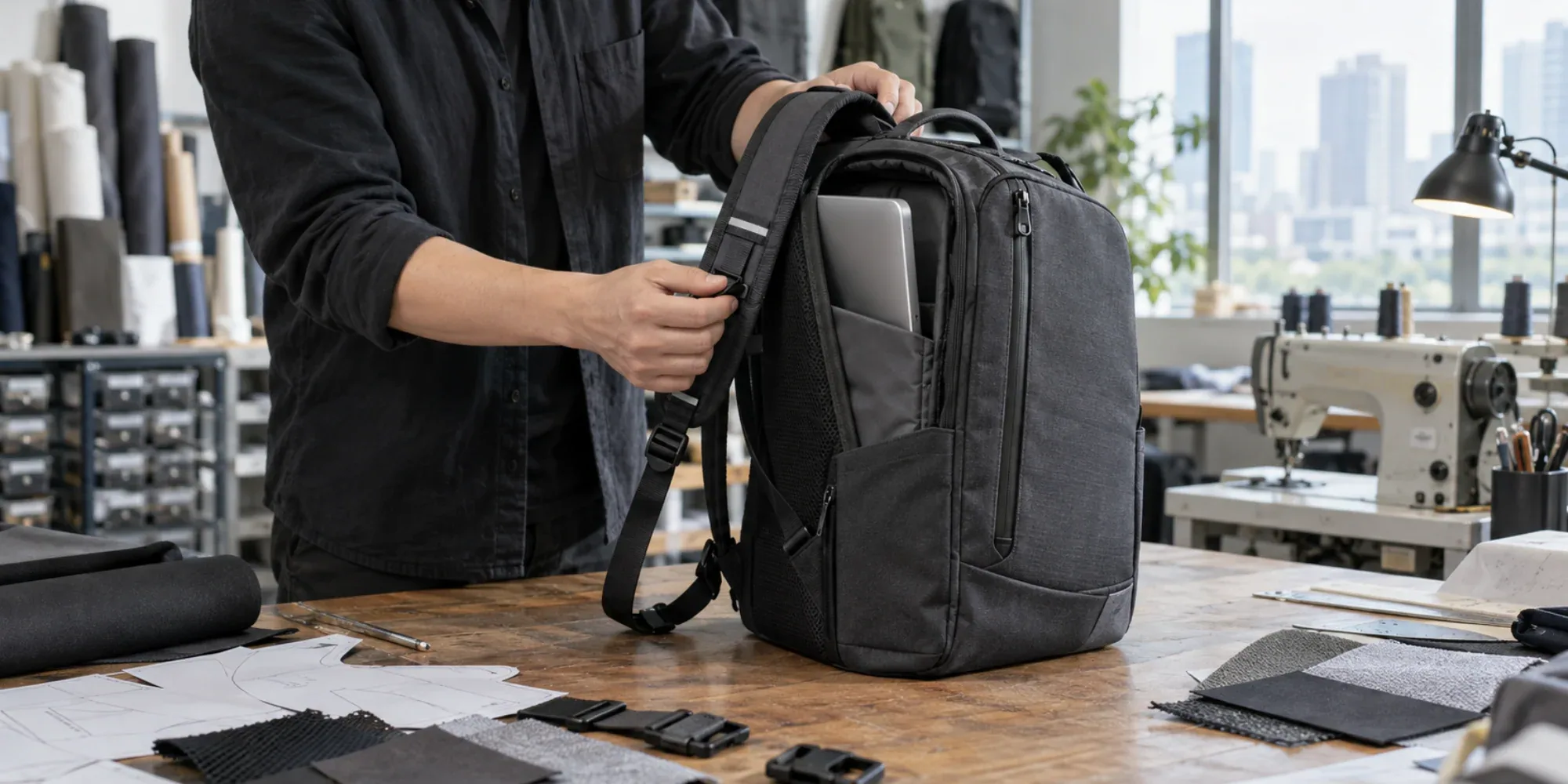
To implement a custom commuter backpack manufacturing project, product developers must define clear functional specifications for daily transit, source materials with verifiable documentation, and establish strict sampling protocols. Unlike general outdoor bags, commuter designs require specialized device protection, structured organization, and weather resistance. Partnering with a manufacturer to execute physical prototyping ensures these functional requirements are validated before mass production. Furthermore, specifying certified materials allows brands to meet regional compliance standards and support their product claims with documented proof.
Defining Structural Specifications for Daily Transit
Product developers translating daily transit needs into physical specifications must distinguish the commuter backpack from outdoor or travel luggage. Commuting involves repetitive motion, tight spatial constraints on public transit, and the protection of fragile electronics. The architecture of the backpack must prioritize vertical load stability and rigid device protection rather than purely maximizing internal volume. When defining these parameters, sourcing managers must specify structural materials rather than just exterior aesthetics, relying on concrete measurements and construction techniques to ensure the final product meets the demands of daily urban travel.
The defining feature of a commuter backpack is its laptop storage. A standard slip pocket is insufficient for transit environments where bags are frequently dropped on hard surfaces. Developers should specify a false bottom that elevates the device, providing adequate clearance to prevent bottom-out impacts. While a full inch was once standard, a smaller suspension clearance of about half an inch successfully prevents base impact without wasting internal vertical volume or disrupting overall proportions. This protective envelope requires high-density foam, such as ethylene-vinyl acetate, rather than low-density polyurethane foam, which compresses too easily under localized impact. Specifying the correct foam thickness, typically five to eight millimeters, balances shock protection with volume constraints.
Commuters carry dense electronics that must sit close to the spine to minimize shoulder fatigue. Manufacturers must structure the back panel to resist bowing under this concentrated weight. Incorporating a high-density polyethylene frame sheet is one effective method for adding rigidity, ensuring the load distributes evenly across the shoulder harness. However, appropriately layered dense foam panels can also successfully prevent the bag from barrel-shaping against the back. Without proper stiffening techniques, the backpack curves outwards, compromising both wearer comfort and device safety.
Harness design for commuting focuses on slim, supportive structures rather than heavily padded hiking harnesses. Articulated straps that follow natural torso curves prevent chafing during active movement. The padding should utilize dual-density foams, comprising a firmer layer against the outer fabric to distribute weight, and a softer layer against the body for comfort. To manage heat dissipation for active commuters navigating diverse climates, back panels often feature molded air channels covered in spacer mesh. However, other ventilation strategies, such as flat perforated foam or suspended mesh panels, also serve as effective alternatives depending on the required profile.
Commuter packs require durable exterior materials with verifiable weather resistance. High-tenacity nylons or polyesters, ranging from four hundred to one thousand denier, provide abrasion resistance against rough transit seating. To achieve weather resistance, developers specify a durable water-repellent face treatment combined with a polyurethane interior backing. While fabrics can be waterproof, seams remain inherent weak points. Standard internal bound seams enclose raw fabric edges to prevent fraying, offering structural protection, but they do not seal the needle holes created during stitching. Relying on traditional binding for weather resistance leaves sensitive electronics vulnerable to water ingress. Achieving actual weather protection requires flat seams sealed with waterproof tape bonded directly to the interior coating, or welded high-frequency construction. While these methods offer superior weatherproofing, they limit design complexity and increase costs. Exterior fabric also impacts structure. Ballistic nylon provides excellent tear strength but adds weight, while other high-tenacity yarns offer a textured matte finish hiding scuffs.
Hardware dictates longevity and weather resistance. Main compartments should utilize reverse coil zippers, which obscure teeth and provide a tighter seal than standard coil zippers. For advanced protection, polyurethane-coated zippers prevent water ingress at vulnerable points. However, coated zippers introduce higher friction, requiring developers to balance water resistance with ease of one-handed operation. High-wear hardware like strap adjusters requires durable materials to withstand daily transit stress. High-quality nylon is a durable, impact-resistant polyamide option designed to yield and flex under pressure. Acetal or aluminum hardware also serves well, offering distinct tactile properties depending on brand positioning.
Internal organization dictates the daily experience of the user. A commuter backpack requires structured segmentation to prevent small items like chargers, pens, and keys from settling at the bottom of the main compartment. Specifying a structured organization panel near the top of the bag keeps frequently accessed items within easy reach while maintaining a balanced center of gravity. Additionally, utilizing high-contrast, lighter-colored lining fabrics, such as a two hundred ten denier ripstop nylon in yellow or silver, significantly improves interior visibility in low-light transit environments, making it easier to locate loose items quickly.
Commuter backpacks generally range from fifteen to thirty-two liters in capacity. While fifteen to twenty-five liters represents the traditional daypack, larger commuter bags up to thirty-two liters easily double as personal items for hybrid workers. Stowability under transport seating is dictated by overall profile, specifically height and depth, rather than a strict volumetric limit. A larger pack fits under a seat if designed with a controlled depth and a streamlined exterior. Sourcing managers must define precise dimensional constraints to ensure compliance with personal item sizes. Depth is particularly critical, as a slim profile prevents catching on turnstiles.
Documenting these specifications requires a comprehensive technical pack detailing every material layer, foam density, and stitching method. Vague instructions lead to inconsistent samples and extended prototyping phases. Developers must clearly define reinforcement techniques like bar-tacking at stress points and internal binding to prevent fraying. Engaging a manufacturer through their Custom Service team early allows managers to review swatches and evaluate foam densities within the physical pattern before committing to a full prototype build. For company-specific information, see GFBags.
Validating Material Sourcing and Regional Compliance
Once the physical architecture of a commuter backpack is established, product developers must select materials that survive daily urban friction while meeting regional regulatory standards. Sourcing managers face a dual mandate where the exterior fabrics must resist abrasion from transport seating and weather exposure, while the underlying supply chain must provide verifiable documentation for market access. Selecting materials for commuting applications requires moving beyond generic fabric descriptions and establishing precise technical thresholds. This phase dictates the long-term viability of the product, as material failure in a commuter bag often results in damage to expensive consumer electronics.
Commuter environments impose distinct wear patterns compared to outdoor or travel scenarios. Backpacks are repeatedly dragged across abrasive surfaces like concrete floors and transit luggage racks. To counteract this, developers should specify high-tenacity face fabrics, typically focusing on nylon or polyester weaves between four hundred and one thousand denier. A higher denier yields a thicker yarn, improving tear strength, but it also increases the overall weight of the bag. Balancing this weight is critical for a pack worn daily. Furthermore, protecting electronics requires robust weatherproofing. Sourcing managers should mandate a durable water-repellent face treatment paired with a strong interior polyurethane coating. This combination prevents water from saturating the outer layer and blocks moisture penetration into the laptop compartment. Relying solely on aesthetic fabric choices without specifying these protective coatings leaves the internal hardware vulnerable to unexpected rain during transit.
Beyond physical durability, sourcing strategies must align strictly with target market regulations. Brands intending to distribute commuter bags within the European Union must navigate highly specific regional compliance frameworks that dictate acceptable chemical use. The European Commission provides official publications and statistics regarding EU textile consumption data, which organizations use to understand the evolving regulatory landscape and environmental expectations for soft goods entering the market. Developers must track these regional requirements to ensure their material choices do not violate restrictions on hazardous substances. Common commuter bag elements, such as water-resistant coatings, plastic hardware, and synthetic dyes, are routinely tested for phthalates, heavy metals, and restricted azo dyes. Failing to align the bill of materials with these consumption and safety guidelines can result in severe consequences, including shipment delays, customs rejections, or the complete inability to sell the inventory in target regions. Because initial physical prototypes routinely use uncertified proxy materials to test shape and fit, sourcing managers must demand compliance declarations for all finalized raw materials before bulk production begins. European Commission, official website
To align with these regional compliance trends and consumer preferences, many product developers specify recycled textiles for their commuter backpack programs. However, transitioning from virgin to recycled synthetic fabrics introduces significant variability in material performance and aesthetics. Mechanical recycling inherently degrades polymer chains, which can affect the baseline strength of the resulting yarn. Therefore, recycled polyethylene terephthalate or recycled nylon must undergo rigorous testing for colorfastness, tear resistance, and tensile strength to verify that the fabric still meets acceptable performance thresholds despite this inevitable structural degradation. Furthermore, recycled yarns frequently exhibit batch-to-batch color variations, making consistent dyeing more challenging than with virgin materials. Sourcing managers should request technical datasheets and lab dip swatches for all proposed recycled fabrics. If the technical specifications fall short of the required durability thresholds for daily commuter use, developers may need to specify heavier weaves or hybrid material blends that restore structural integrity while still incorporating a defensible percentage of recycled content.
Specifying sustainable materials requires more than requesting recycled yarn from a supplier. It necessitates strict chain-of-custody documentation to substantiate brand marketing claims. Without verifiable proof, product developers risk accusations of greenwashing, which can severely damage brand reputation. Sourcing managers must therefore require suppliers to provide valid third-party certifications for any recycled content claims. Established certification bodies deliver comprehensive assessments that trace the recycled input from the source to the final fabric. For instance, SCS Global Services launched the first third-party certification program for recycled content claims in 1989 and conducts detailed evaluations to verify these claims. By requiring materials validated by a recognized authority, procurement teams ensure that their sustainability metrics are backed by verified audits rather than generic supplier promises. Recycled Content Certification | ISO 14021 & SCS‑103 | SCS
Securing this documentation also enables brands to protect their intellectual property and market positioning. When a custom backpack manufacturer utilizes certified sustainable inputs, the product developer needs a mechanism to transfer that verification to their own consumer-facing brand. Customers of certified manufacturing facilities can utilize private label certification from organizations like SCS Global Services. This structural pathway allows businesses to re-brand and market these certified goods under their own company name. By structuring the sourcing agreement to include private label certification transfers, product managers can confidently print recycled content claims on their packaging and internal labels, knowing the underlying documentation perfectly matches their corporate entity. Recycled Content Certification | ISO 14021 & SCS‑103 | SCS
Implementing these material choices requires updating the technical pack and the bill of materials to reflect both performance and compliance requirements simultaneously. Every fabric, lining, and hardware component listed in the specification document should explicitly name the required material grade, coating type, and acceptable certification standard. When sourcing managers submit this comprehensive document to their manufacturing partner, it removes ambiguity and prevents unauthorized material substitutions during bulk production. A strict procurement protocol dictates that any proposed alternative material must be submitted with its corresponding compliance certificates and tested against the original performance baseline. This rigorous documentation bridges the gap between design intent and physical production, ensuring the commuter backpack delivers on both its structural promises and its regulatory obligations. For company-specific information, see GFBags.
Executing Iterative Prototyping and Rapid Sampling
Translating structural specifications and material choices into a physical commuter backpack requires strict sampling protocols. A technical pack provides the architectural blueprint, but a two-dimensional document cannot fully predict how stiff fabrics, layered foams, and heavy-duty hardware will interact once stitched together. The prototyping phase bridges this gap, allowing product developers to validate spatial dimensions, load distribution, and compartment accessibility before authorizing mass production. Skipping or rushing this physical validation often results in systematic manufacturing errors that are impossible to correct once a bulk fabric order is cut.
The prototyping process typically begins with translating the technical pack into a digital pattern, followed by the assembly of a preliminary first sample. During this initial stage, sourcing managers and developers should evaluate the fundamental geometry of the bag rather than perfection in stitching. The primary objective is to verify that the pattern pieces correctly form the intended volumetric shape and that commuter-specific dimensions, such as depth and height constraints for under-seat transit storage, match the original brief. It is common for the first sample to use uncertified proxy materials if the specified custom-dyed fabrics are still in production, provided the proxy fabrics closely mimic the weight and drape of the final selections.
Once the base geometry is confirmed, the evaluation shifts to compartment usability, which dictates the daily transit experience of the commuter. Product developers must physically test the laptop and device sleeves using actual hardware to ensure the false bottom suspension functions correctly. If a heavy laptop sinks to the bottom seam when inserted, the internal pattern requires immediate revision to restore the protective clearance. Similarly, the accessibility of small item organization panels must be tested. Developers should simulate real-world transit scenarios, such as retrieving a travel pass or charging cable while the bag is swung over one shoulder. If structured pockets collapse or reverse-coil zippers snag on interior linings during these maneuvers, the manufacturer must adjust the internal binding or stiffen the surrounding fabric layers in the next prototype.
Hardware functionality requires equally rigorous physical testing during the sampling phase. Water-resistant polyurethane-coated zippers, frequently specified for commuter bags, naturally exhibit higher friction than standard coil zippers. Prototyping reveals whether the zipper tape has been sewn with enough clearance to navigate corners smoothly or if the track creates binding points that prevent one-handed operation. Furthermore, load-bearing hardware such as shoulder strap adjusters and sternum strap sliders must be evaluated under tension. Slippage often occurs when the chosen webbing is too thin or slick for the selected acetal buckle. Identifying this mismatch during sampling allows the sourcing manager to swap the webbing texture or specify a different buckle geometry before ordering mass quantities.
Static inspection cannot validate load distribution, making dynamic wear testing essential during prototyping. Product developers must pack the sample with a standard commuter load, typically a laptop, tablet, water bottle, heavy power bank, and a change of clothes, to evaluate how the bag behaves under weight. The evaluation should focus on the structural integrity of the back panel and the ergonomics of the shoulder harness. If the back panel bows outward and compromises the flat plane necessary for device protection, the internal structure must be reinforced or modified. Designers can address this by increasing the frame sheet thickness, upgrading the material, or adding structural stays without necessarily increasing overall weight. Wearers should also assess whether the dual-density foam in the shoulder straps successfully distributes the concentrated load without digging into the neck or shoulders during active movement.
Iterative refinement is inherent to custom backpack manufacturing. Feedback from the initial sample inevitably leads to pattern adjustments, material substitutions, or updated hardware tolerances. Product developers must document these required changes meticulously in an updated technical pack to ensure the manufacturing partner understands the exact mechanical corrections needed. Subsequent prototypes are constructed until all functional and aesthetic requirements are met. The final physical iteration, known as the pre-production sample, is built using the exact bulk materials, certified fabrics, and custom hardware intended for the final product. This sample serves as the ultimate benchmark for the entire project.
Approving the pre-production sample locks the physical design and establishes the definitive quality standard for the manufacturing run. Sourcing managers use this finalized prototype to verify production costs, finalize the bill of materials, and establish acceptable quality control tolerances. Once physical validation is complete, the project transitions from development into procurement and mass production, shifting focus toward maintaining this established standard across thousands of identical units.
Establishing Mass Production and Quality Control Protocols
Transitioning from an approved pre-production sample into mass manufacturing shifts a product developer's focus from design iteration to supply chain execution and batch consistency. The approved sample serves as the definitive physical standard for the production run. The core challenge is replicating exact tolerances, such as the protective laptop suspension clearance and the precise alignment of hardware, across thousands of units without deviation. Establishing strict procurement and quality control protocols prevents systemic manufacturing errors that compromise utility. A successful transition requires creating detailed standard operating procedures, translating the technical pack into instructions that production lines follow consistently.
Sourcing managers must first align the required bill of materials with manufacturer minimum order quantities. Custom commuter backpacks often utilize specialized inputs like high-density ethylene-vinyl acetate foam, custom-dyed high-tenacity nylons, and specific heavy-duty hardware. These proprietary materials dictate higher volume requirements than standard off-the-shelf fabrics. If a brand cannot meet a fabric mill order threshold, they may need to compromise by selecting stock colors or consolidating fabric orders across multiple lines. Negotiating procurement thresholds early prevents sudden material substitutions on the production line, which could downgrade abrasion resistance or structural rigidity. Understanding lead times associated with custom components ensures production schedules remain realistic.
Quality control protocols begin before any fabric is cut. When bulk materials arrive at the facility, procurement teams rely on incoming quality control to verify raw inputs against the technical pack. For commuter bags, inspectors must verify that heavy-duty exterior fabrics match the approved lab dip for color consistency and possess the correct durable water-repellent coating. Testing foam density is equally critical. If a factory accepts a softer batch of polyurethane foam instead of the specified high-density padding, the final bags will lack the rigidity required to protect electronics from impacts. Furthermore, certified sustainable materials require verification of batch-specific transaction certificates to maintain an accurate chain of custody.
During the cutting and sewing phases, in-process quality control focuses on structural reinforcement and assembly tolerances. Commuter backpacks feature complex architecture around the back panel and harness attachment points where laptop weight concentrates. Quality inspectors verify that heavy-duty bar-tacks are placed exactly at high-stress junctions, such as the shoulder strap base. To ensure durability, internal seam bindings must be tightly finished without dropped stitches; this strictly prevents fraying of the internal fabric edges. However, standard sewn binding does not minimize water ingress. Attempting to apply heat-sealed waterproof seam tape over a bulky, bound seam is physically impractical and fails to create a reliable seal. Achieving true weather resistance at these vulnerable junctions requires transitioning to a flat seam construction. This allows the waterproof tape to be bonded directly to the flat interior coating of the fabric, a separate process that must be independently monitored for complete adhesion.
Assembly checks heavily focus on hardware installation tolerances. Commuter bags frequently rely on reverse-coil or polyurethane-coated zippers to protect internal compartments. These specialized zippers require precise sewing to function properly. If sewing operators stretch the zipper tape during installation or fail to maintain mechanical clearance around the slider, the track will wave or bind, creating friction that frustrates users attempting to open the bag single-handedly. Inspectors should pull random sub-assemblies from the sewing line to perform functional tests, ensuring buckles snap securely, strap adjusters hold under tension, and coated zippers glide smoothly under simulated realistic loads.
Final quality assurance dictates whether a batch is approved for shipping based on Acceptable Quality Limit standards. Sourcing managers typically specify standardized inspection levels, such as an Acceptable Quality Limit of 1.5 for major defects and 4.0 for minor defects. A major defect in a commuter bag might include a failed load-bearing seam, an improperly suspended laptop sleeve, or a missing weather-resistant coating, all directly impacting core function. Minor defects involve aesthetic issues like loose internal threads or misaligned woven labels. Final inspections should also include physical load testing, such as jerk-testing shoulder straps with a weighted dummy load to simulate a heavy commute, verifying that harness stitching holds under sudden force.
The final step is packaging the commuter backpacks to preserve structural integrity during freight. Commuter bags designed with rigid frame sheets and molded foam back panels cannot be crushed, folded, or vacuum-sealed into cartons without risking permanent creasing. Manufacturers must use appropriate internal stuffing, such as tissue paper or inflatable air bladders, to maintain the three-dimensional shape of the bag. Shipping cartons must be dimensioned to allow finished bags to sit flat or stand upright without compression. Enforcing these packaging protocols ensures that the precise structural properties validated during prototyping successfully survive global transit and arrive exactly as specified.