 Skip to content
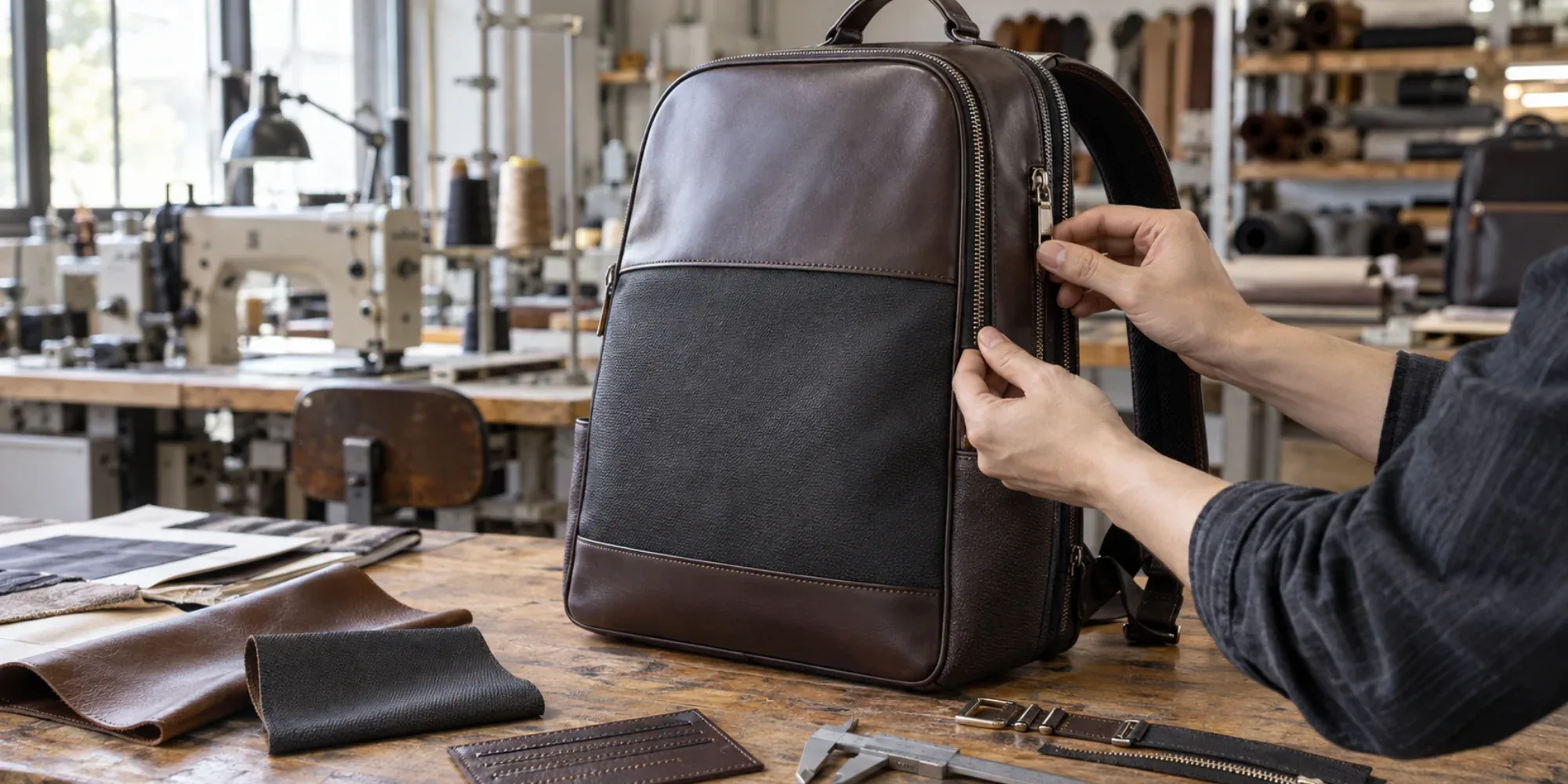
To manufacture Louis Vuitton-adjacent custom backpacks, sourcing managers must evaluate factories against a rigorous capability checklist focusing on structural integrity, precision craftsmanship, custom hardware tooling, and stringent quality control. A capable manufacturer demonstrates mastery of complex tech packs, precise pattern-making, edge finishing, and documented material traceability rather than relying on standard off-the-shelf templates.
Defining the Technical Baseline for Luxury Manufacturing
Sourcing backpacks at a luxury standard requires moving beyond basic structural capacity to evaluate a factory's technical precision. When comparing a potential manufacturer against premium quality tiers, the evaluation begins with measurable construction tolerances rather than subjective aesthetics. Standard promotional bag production prioritizes speed and volume, relying on automated templates and wide tolerances. In contrast, premium backpack manufacturing demands deliberate pacing, specialized machinery, and operators capable of executing highly precise manual tasks across varying material thicknesses.
A primary indicator of a factory's capability is its control over stitch density, thread selection, and tension. Luxury goods generally require a higher stitch-per-inch count, often ranging from eight to twelve depending on the seam. Manufacturers utilize heavy bonded nylon or specialized polyester threads that resist abrasion. However, executing this requires technical precision. When working with full-grain leathers, an excessively high stitch count acts like a perforation line, weakening the hide rather than strengthening the seam. The stitch density must be carefully managed to avoid perforating and tearing the material. Additionally, sewing heavy leathers requires appropriately sized, specialized needles, such as leather cutting points, that match the thread weight. Using fine needles causes thread shredding and needle breakage because the eye is too small to accommodate thick bonded thread. Evaluators must inspect sample seams for consistent tension, ensuring no loops or skipped stitches exist where multiple layers and stiffeners converge at structural anchors.
Edge treatment is another critical baseline metric separating luxury construction from mid-tier manufacturing. While standard bags use simple turned edges or basic fabric binding to hide raw cuts, high-end backpacks incorporate meticulously painted or burnished edges. A capable manufacturer demonstrates a multi-step edge painting process: applying a base coat, heat-drying, sanding, and applying subsequent layers until the edge feels entirely smooth and unified. This time-intensive process requires significant manual dexterity. When inspecting edge treatments, sourcing managers should look for uniform thickness, absence of bubbling, and clean transitions where different panels meet.
Pattern matching and panel symmetry introduce significant complexity into the cutting and assembly phases. For brands utilizing repeating monograms or distinct grain directions, the manufacturer must align these motifs flawlessly across seams and side gussets. This alters material yield calculations and demands highly skilled cutters or advanced optical cutting machinery. A factory claiming luxury capabilities must document its pattern-matching protocols and maintain exact visual alignment without warping the three-dimensional structure. Furthermore, the manufacturer must manage tension variations introduced by skived edges and internal reinforcements, ensuring the exterior alignment remains undistorted. By establishing these measurable technical baselines, sourcing teams can quickly filter out manufacturers unequipped for the rigorous demands of high-end production.
Material Sourcing, Verification, and Traceability
Producing a Louis Vuitton-adjacent custom backpack requires a material sourcing network capable of delivering consistent, premium substrates such as full-grain leathers, coated canvases, and specialized technical fabrics. A sourcing manager must evaluate a manufacturer's supply chain transparency, moving beyond simple material availability to verify the origin, batch-to-batch color consistency, and structural integrity of every component. A factory capable of high-end production maintains documented relationships with reputable tanneries and textile mills, rather than relying on open-market purchases. This direct relationship allows the manufacturer to demand strict tolerances for raw material defects, ensuring only pristine hides and textiles enter the cutting room.
When a premium brand incorporates sustainable materials into its luxury positioning, unverified factory claims introduce compliance risks. To prevent greenwashing, sourcing teams must require third-party verification for recycled content. SCS Global Services states it launched the first third-party certification program for recycled content claims in 1989 and provides comprehensive assessment and certification today. Notably, SCS Global Services notes that a private label certification is available to customers of certified manufacturers, allowing the re-branding of certified products under the customer's company name. Luxury-tier manufacturers should readily provide these verifiable certificates rather than asking brands to trust internal supplier claims. Recycled Content Certification | ISO 14021 & SCS‑103 | SCS
Material traceability is equally vital for regulatory compliance, particularly when distributing high-end goods globally. Brands planning to sell in markets that monitor supply chain origins must ensure their manufacturing partners maintain robust traceability data. For example, European authorities actively monitor sustainability metrics; official platforms like the European Commission website support organization-controlled statements and statistics directly relevant to EU textile consumption data. If a custom backpack manufacturer cannot accurately map its supply chain to meet these regional expectations, the brand may face significant complications with regulatory reporting. Capable luxury factories use advanced enterprise resource planning systems to track specific lot numbers from the raw material mill directly to the finished backpack. European Commission, official website
The physical storage of premium raw materials offers another observable metric for a factory evaluation. High-quality hides or technical canvases can be compromised by improper climate control or careless stacking. A high-end manufacturer demonstrates strict inventory management, ensuring coated fabrics are stored in temperature-controlled environments so they do not stick together or degrade in high humidity. Premium leathers must be stored flat or rolled carefully on wide tubes to prevent permanent creasing before cutting begins. Sourcing managers should deliberately add these specific material verification and handling steps to their operational checklists.
- Verify direct purchasing relationships with premium mills and tanneries rather than secondary wholesalers.
- Demand third-party certificates for recycled claims to enable compliant private label branding and avoid greenwashing.
- Confirm the factory can track specific material lot numbers to individual production batches to support international market compliance.
- Inspect the storage facility for climate control, proper resting practices for leather, and protective staging for coated canvas.
Integrating these verification steps ensures that the foundation of the backpack meets luxury expectations before assembly begins. For general background information on a supplier's standard operations, sourcing managers may consult the manufacturer's capabilities, though a physical audit remains mandatory for confirming high-end material handling practices in person. Without verifiable sourcing and stringent storage protocols, the final product will inevitably fall short of the targeted quality standard. For company-specific information, see GFBags.
Internal Construction and Structural Integrity
While external stitching is immediately visible, the defining characteristic of a Louis Vuitton-adjacent backpack is its hidden internal architecture. High-end backpacks maintain their distinct silhouette regardless of whether they are empty or fully loaded. Standard promotional bags often collapse under weight because they rely almost entirely on the outer shell for shape. Evaluating a manufacturer for premium capabilities requires looking past the exterior to assess how they engineer the internal framework.
A critical component of this framework is the manufacturer's approach to interlining. Sourcing managers must verify the factory's ability to apply specialized stiffeners, such as bonded leather, high-density EVA foams, and technical non-woven textiles. Unlike basic production that uses uniform padding throughout the bag, luxury construction demands precise interlining mapping. A capable factory applies distinct substrates to different zones, utilizing rigid structural boards for the base to prevent sagging, while employing layered, flexible foams in the shoulder straps to balance comfort with long-term durability.
Skiving capabilities form another essential evaluation category. When working with full-grain leathers or heavy synthetics, joining multiple layers creates excessive bulk at the seams. This bulk distorts the intended shape and introduces weaknesses where needles struggle to penetrate evenly. Premium factories utilize precision skiving machinery to shave down material thickness exactly at the joining margins before assembly. This technique is reserved for solid materials; shaving woven fabrics severs structural yarns and causes unraveling. Evaluators should inspect prototype seams for smooth, flat transitions without bulging.
Finally, anchoring load-bearing points dictates the backpack's longevity. While luxury goods frequently utilize highly visible exterior stitching at handle and strap mounts as deliberate structural and aesthetic hallmarks, the crucial difference lies beneath the surface. A premium manufacturer adds concealed internal backings—such as embedded nylon tape or supplementary patches—sandwiched between the outer shell and lining. This hidden reinforcement distributes carrying tension across a wider area, preventing the visible exterior from stretching over time. Additionally, the interior lining must be patterned precisely; a loose lining snags, while a tight lining pulls against external seams and warps the structure. Sourcing managers should utilize this structural checklist during audits.
- Interlining mapping: Confirm the use of varied, zone-specific substrates like bonded leather or dense EVA foam rather than uniform padding.
- Precision skiving: Check that leather and solid synthetics are shaved down at margins to prevent bulky seams.
- Concealed reinforcements: Verify that hidden anchoring materials are embedded behind visible strap attachments to distribute load tension.
- Lining tension: Inspect the lining pattern to ensure it matches the external shell volume without bagging or pulling.
Custom Tooling and Hardware Precision
While fabrics form the body of a luxury backpack, the metal components often dictate its perceived value and tactile experience. Standard promotional bags rely heavily on off-the-shelf zippers, basic stamped D-rings, and generic buckles sourced from open-market catalogs. Producing at a Louis Vuitton-adjacent tier demands the complete opposite: hardware that functions as both a structural anchor and a precise, branded element. Sourcing managers must determine whether a manufacturer has the established supply chain to engineer proprietary tooling. A factory must demonstrate the capability to produce custom molds, typically utilizing solid brass or zinc alloys, to create proprietary shapes that cannot be found on a generic platform.
The finishing process for these components is equally critical. Generic hardware usually undergoes barrel plating, a high-volume process that tumbles parts together, resulting in micro-scratches and uneven coatings that chip quickly. Luxury manufacturing necessitates rack plating, where individual pieces are hung separately to ensure a flawless finish, or advanced deposition processes for extreme durability. Sourcing teams should not accept visual inspections alone. Evaluators must request documentation detailing the plating thickness in microns and require standardized salt spray test results to prove long-term corrosion resistance. Zippers, for example, demand close inspection. While luxury metal zippers require individually polished teeth rather than standard unpolished stamped teeth to ensure a smooth glide, premium backpacks also appropriately utilize high-end, specialized nylon or extruded plastic coil zippers for flexible or technical closures.
Beyond aesthetics, a premium factory must master the mechanical integration of these custom components. Hardware must interact flawlessly with surrounding textiles. If a custom buckle is too heavy, it will distort the drape of a supple leather, causing the bag to sag over time. If the tolerance on a strap adjuster is too wide, the backpack will slip under load; if too narrow, the user will struggle to resize the strap. Evaluators must carefully check these dimensional tolerances, ensuring that every clasp engages with a definitive, engineered snap rather than a hollow click.
- Proprietary tooling: Verify the manufacturer can facilitate custom molds for solid brass or zinc alloy components rather than substituting generic parts.
- Plating and finishing protocols: Require documented salt spray test reports and verify the use of rack plating or advanced deposition methods for metal hardware.
- Component integration: Check dimensional tolerances to ensure straps thread smoothly through adjusters without unwanted slippage or excessive friction.
- Mechanical action: Test the operational feel of all moving parts, requiring properly tensioned clasps and appropriate zipper selections.
Confirming these hardware tolerances early in the evaluation prevents costly delays during prototyping. When a factory can execute proprietary hardware development with exact precision, they prove their capacity for luxury-tier production. Sourcing teams should request comprehensive technical documentation from any prospective manufacturer to understand exactly how proprietary components are integrated into the manufacturing timeline and custom service operations. For company-specific information, see GFBags.
Prototyping and Tech Pack Translation
The prototyping phase is the first physical test of a custom backpack manufacturer. Evaluating how a factory translates a comprehensive tech pack into a first-round sample reveals the depth of their in-house engineering and pattern-making expertise. Louis Vuitton-adjacent quality relies on complex geometries, structural reinforcements, and tight stitching tolerances that standard promotional bag factories rarely encounter. When sourcing managers submit a tech pack, the factory response is a strong indicator of capability. A high-end manufacturer will conduct a technical review, questioning material compatibility, hardware load bearings, and seam constructions before cutting any fabric.
To assess engineering capability during the sampling phase, product developers should include specific prototyping checkpoints in their vendor evaluation checklist.
- Dedicated sample room: Verify that the manufacturer employs specialized pattern makers and sample sewers rather than pulling production line workers for prototyping.
- Tech pack translation: Request examples of how the factory converts client tech packs into internal manufacturing instructions and bills of materials.
- Pattern precision: Evaluate the physical sample for accurate grading, precise skiving margins on leather or heavy synthetic components, and exact seam allowances.
- Feedback integration: Track the factory ability to document and execute micro-adjustments across iterative sampling rounds without introducing new defects.
The transition from a two-dimensional design to a three-dimensional luxury backpack requires deep structural understanding. Premium materials behave differently depending on how they are backed, folded, and stitched. A competent pattern maker anticipates these variables, calculating precise material yields and adjusting patterns to accommodate the thickness of interlinings or the specific drape of a coated canvas or heavy leather. If a prototype returns with collapsed gussets, puckered seams, or hardware that restricts zipper movement, it indicates a gap in the factory structural engineering.
Furthermore, the iteration cycle itself is a critical metric for a sourcing manager. Luxury goods often require multiple rounds of micro-adjustments to perfect the hand-feel, structural rigidity, and edge finishing. The accuracy with which a factory implements these revisions separates high-end partners from standard vendors. A manufacturer capable of producing premium bags will systematically document each revision, updating the internal bill of materials and technical drawings to ensure that the approved prototype can be replicated precisely during the mass production run.
In-line Quality Control and Manufacturing Tolerances
Transitioning from a successful prototype to a full production run introduces the challenge of scale. For standard promotional bags, factories typically rely on Acceptable Quality Limit random inspections conducted at the end of the production line. However, producing Louis Vuitton-adjacent custom backpacks requires a paradigm shift from reactive to proactive quality control. Relying solely on end-of-line inspections is a critical failure point in luxury manufacturing. Once heavy coated canvas or full-grain leather is punctured, needle holes are permanent; a mistake cannot be unpicked and restitched without destroying the material's aesthetic value. Therefore, a capable high-end manufacturer mandates continuous in-line quality control at every sub-assembly stage, ensuring defects are identified and discarded before the backpack is fully assembled.
The first line of defense in maintaining tight manufacturing tolerances occurs immediately after cutting. Before stitching begins, dedicated personnel must inspect every cut panel. For premium materials, this involves examining leather hides or technical fabrics under high-lux lighting to identify natural scars, inconsistent grain patterns, or dye variations that slipped past initial receiving. The factory must demonstrate a strict tolerance policy for panel dimensions. While standard manufacturing might accept a sizing variance of up to five millimeters, luxury construction often restricts this tolerance to one millimeter or less for precise cutting stages. If a panel is cut outside this exact parameter, it significantly increases the risk of puckering or structural distortion when joined to adjacent pieces during final assembly.
As production moves to the sewing floor, sourcing managers should verify the presence of roving in-line inspectors. These technicians monitor individual workstations to verify that hidden structural elements meet the exact design specifications. A key checkpoint is the internal architecture before the lining is attached. Inspectors must physically verify that interlining materials are mapped correctly, skived edges are uniformly shaved to the required thickness, and concealed reinforcements are properly anchored behind load-bearing hardware. Because these elements will eventually be hidden, factory floor documentation and in-line sign-offs are a primary operational proof—alongside destructive testing, which involves tearing down finished samples—that the internal construction matches the approved tech pack.
- 100% Panel Inspection: Verify that every cut piece is checked for dimensional accuracy and material flaws before reaching the sewing floor.
- Sub-Assembly Checkpoints: Ensure formal inspection stations exist after critical manual stages, such as edge painting, strap construction, and hardware setting.
- Tolerance Enforcement: Request to see the documented acceptable variance limits for stitch-per-inch counts, seam allowances, and pattern symmetry.
- Defect Segregation: Observe how the factory handles rejected components; there should be a clear, immediate quarantine process to prevent flawed parts from re-entering the active production line.
Finally, the end-of-line inspection process must reflect luxury handling standards. Beyond checking for loose threads or hardware functionality, final quality control must measure the backpack for overall symmetry, ensuring straps are perfectly mirrored and side gussets sit identically. High-end factories will also employ protective handling procedures during this stage, requiring inspectors to wear soft gloves to prevent oil transfer onto premium leathers and applying protective films over custom electroplated hardware. A manufacturer that systematically executes these tight tolerances and rigorous in-line checks demonstrates the operational maturity necessary to sustain a premium bag program across multiple large-scale production cycles.
Factory Compliance and Documentation
Sourcing high-end custom backpacks exposes a brand to significant reputational risk if the factory fails to meet ethical or legal labor standards. A luxury manufacturer must demonstrate compliance through independent, recognized audits. Standard promotional bag factories might operate with minimal oversight or expired certifications, but a factory operating at a Louis Vuitton-adjacent tier will maintain current, verifiable documentation.
The core of this documentation includes social compliance audits such as amfori BSCI, SMETA, or SA8000. These frameworks evaluate fair compensation, working hours, occupational health and safety, and grievance mechanisms. Sourcing managers should not accept a simple acknowledgment of compliance; they must request the full audit report and review any Corrective Action Plans from recent inspections. A high-end factory proactively shares this documentation and demonstrates a history of resolving minor infractions before they escalate. Quality management certifications, such as ISO 9001, further prove that the factory has standardized procedures for tracking defects and managing workforce training.
Beyond labor and quality management, luxury brands require strict facility security to protect intellectual property. Producing a proprietary custom backpack means sharing intricate tech packs, custom hardware molds, and unreleased designs. A capable manufacturer enforces stringent physical and digital security protocols. Evaluators should check for restricted access to sample rooms, secure storage for proprietary custom hardware molds, and strict non-disclosure agreement enforcement across the workforce. Factories must also demonstrate how they prevent unauthorized production overruns, ensuring that defective units or surplus branded materials do not enter the gray market.
- Recent Social Audits: Request full, unredacted reports from the past twelve months rather than just a summary certificate.
- Quality Management Systems: Verify active certifications covering the specific facility location to ensure standardized defect tracking.
- IP Security Measures: Inspect physical access controls to the cutting and sample rooms, and verify secure storage for custom proprietary molds.
- Overrun Destruction Protocols: Confirm documented procedures for destroying rejected components or branded hardware to prevent unauthorized market leaks.
Integrating these documentation checks finalizes the administrative evaluation of a vendor. Only when a factory proves its adherence to international labor standards and actively protects the brand's intellectual property can it be considered a secure partner for luxury production.
The Executive Vendor Capability Checklist
Evaluating a custom backpack manufacturer for luxury-tier production requires a structured approach during physical audits. Sourcing managers can use this consolidated checklist to score a factory's specific technical competencies against Louis Vuitton-adjacent standards. This tool moves beyond generic capacity claims, focusing entirely on observable factory floor practices and verifiable documentation.
| Evaluation Category | Capability Check | Observable Evidence or Documentation |
|---|---|---|
| Stitching & Construction | Consistent tension at eight to twelve stitches per inch without needle damage to substrates. | Physical inspection of seams on heavy coated canvas or full-grain leather prototype samples. |
| Material Sourcing & Storage | Direct relationships with premium tanneries and climate-controlled raw material storage. | Verified material lot traceability systems and documented third-party sustainability certificates. |
| Internal Architecture | Zone-specific interlining mapping and concealed reinforcements at structural load-bearing points. | In-line inspection of skived leather margins and hidden anchors before final lining attachment. |
| Custom Hardware | Proprietary mold development and flawless mechanical integration of metal components. | Salt spray test reports and plating thickness metrics for rack-plated brass or zinc alloy hardware. |
| Prototyping & Engineering | Accurate translation of complex tech packs into functional, three-dimensional physical prototypes. | Iterative sampling documentation, internal bills of materials, and dedicated in-house pattern-making teams. |
| Quality Control | 100% pre-sewing panel inspection and roving in-line checks at critical sub-assembly stations. | Documented acceptable variance limits strictly enforced under one millimeter for rigid components and precision cutting stages. |
| Compliance & Security | Adherence to international labor standards and rigorous protection of brand intellectual property. | Unredacted social audit reports and physically secured sample rooms for proprietary molds. |
Using this matrix during an initial evaluation prevents sourcing managers from advancing unqualified vendors to the sampling stage. Each category represents a non-negotiable requirement for high-end backpack manufacturing. If a factory relies entirely on end-of-line visual inspections or substitutes generic hardware for custom tooling to cut costs, they cannot sustain the tolerances required for premium positioning. Sourcing teams must demand physical proof for each checklist item, prioritizing observed operational maturity over verbal assurances.
When executing the physical audit, sourcing managers should weight structural engineering and in-line quality control the heaviest. A facility might present immaculate compliance documents or a pristine climate-controlled warehouse, but if floor supervisors cannot enforce precise cutting tolerances or execute complex leather skiving, the final backpack will inevitably fail. Evaluators should request to track a single production batch from the cutting room through to final assembly to verify that these checklist protocols operate simultaneously in a live production environment.