 Skip to content
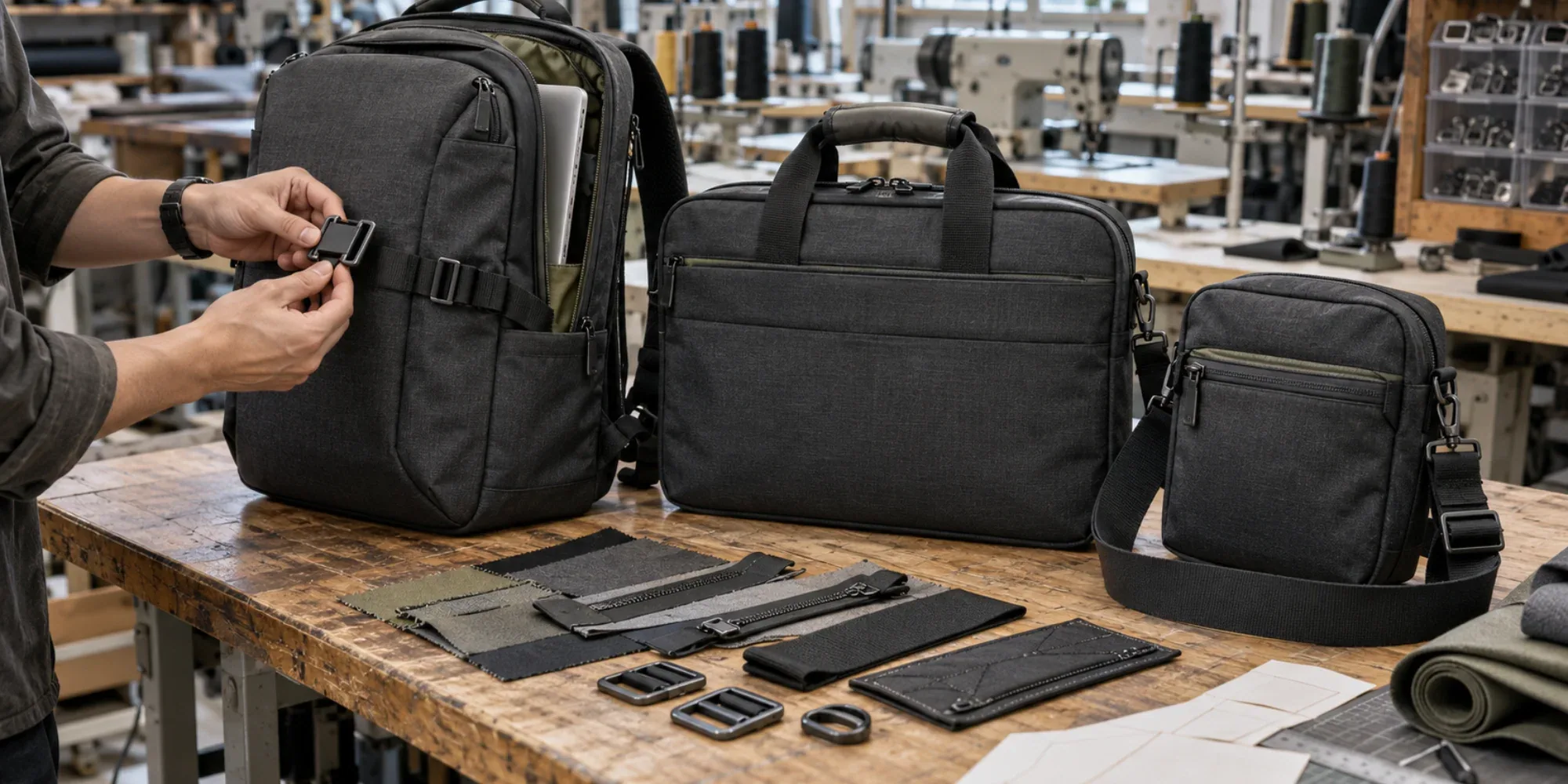
Implementing a commuting bag line requires translating urban transit needs into precise manufacturing specifications, selecting verifiable materials, and testing structural integrity through a rigorous sampling process. Sourcing managers must define laptop clearances, weather resistance, and load distribution in a comprehensive tech pack, then work with the manufacturer to source appropriate textiles and validate durability before authorizing mass production.
Translating Commuter Needs into Technical Specifications
The transition from a commuting bag concept to a tangible product relies heavily on the quality of the technical specifications provided to the manufacturer. A tech pack serves as the definitive blueprint, translating the daily demands of urban transit into actionable instructions for the factory floor. Unlike generic tote bags or basic promotional backpacks, commuting bags must manage significant load variations, protect fragile electronics, and withstand unpredictable weather conditions. Sourcing managers and product developers must move beyond subjective descriptions like durable or comfortable, replacing them with objective measurements, exact material references, and clear construction diagrams to ensure consistency.
The most critical element in any commuting bag is the laptop compartment. Rather than simply requesting a padded pocket, developers must specify a suspended sleeve design. A suspended sleeve prevents the laptop from striking the ground when the user sets the bag down abruptly on a hard surface. The tech pack should dictate the exact clearance gap between the bottom of the laptop pocket and the exterior bottom panel of the bag. Clearances typically range from one to two inches, depending on the base material flexibility and the overall bag silhouette. Furthermore, the dimensions of the compartment must account for the actual thickness of modern devices alongside protective cases, ensuring a secure fit that prevents lateral shifting during a busy commute.
Padding specifications require careful detailing to ensure device protection and user comfort over long durations. Merely listing foam on the bill of materials leaves the factory guessing about the required stiffness and compression rate. The technical documentation must specify the type, thickness, and density of the foam. For laptop sleeves and base panels, closed-cell ethylene-vinyl acetate foam is frequently specified due to its high density and structural rigidity, which absorbs impacts effectively without adding excessive weight. For shoulder straps and back panels, a combination of a firm base foam for structure and a softer open-cell foam against the body often provides the necessary load distribution and comfort for extended wear during a walking or cycling commute.
Weather resistance is another non-negotiable requirement for commuting lines, as users routinely carry valuable electronics through rain and snow. The tech pack must outline the specific mechanisms used to keep moisture out of the main compartments. This involves more than just selecting a water-resistant face fabric. Product developers must specify the type of closures, such as polyurethane-coated zippers or reverse coil zippers, which provide a tighter seal than standard molded plastic zippers. Additionally, construction details like rain flaps, fabric welts over zipper tracks, and internal seam-sealing tape should be clearly diagrammed. Applying seam-sealing tape with appropriate heat and pressure is the necessary mechanism to prevent water ingress through needle holes, which are typical weak points in sewn soft goods.
Load distribution and accessibility dictate how effectively a commuter bag functions in crowded environments like subways or buses. The tech pack must detail the anchor points for shoulder straps and top grab handles. Reinforcement methods, such as heavy bar-tacking, box-and-X stitching, or internal backing plates, should be explicitly called out on the construction pages. These reinforcements prevent tear-out when the bag is repeatedly lifted while fully loaded with heavy items like laptops, water bottles, and thick documents. Furthermore, the placement of quick-access pockets for transit cards or keys should be mapped out carefully, specifying the exact angle and depth to ensure they are accessible without exposing the main compartment to theft or severe weather.
Internal organization requires precise measurement to be functional for the daily user. Commuters carry a specific ecosystem of accessories, including chargers, cables, external drives, and pens. Pockets designed for these items must have specific width and depth measurements, and the material choices for these internal organizers should be thoroughly documented. Using high-contrast lining fabrics, such as bright yellow, orange, or light gray, improves interior visibility, making it much easier for users to locate small items in low-light transit environments. The tech pack should include a full bill of materials for these internal elements, detailing the mesh types, elastic binding tension, and the exact lining fabrics utilized across all compartments.
Effective communication with the factory also involves establishing realistic tolerances for these specifications. No manufacturing process is perfectly exact, and textiles stretch and shift naturally during sewing. By defining acceptable variance margins for critical dimensions, such as the width of the laptop sleeve or the length of the shoulder straps, developers prevent costly misalignments during mass production. Navigating the transition from initial sketches to factory-ready documentation requires a well-defined tech pack to prevent assumptions on the sewing line. For company-specific information, see GFBags.
Ultimately, the tech pack is a living document that evolves as the bag moves from initial concept through the physical sampling phases. However, the initial draft must be as comprehensive as possible to set a baseline for the first functional prototype. A thorough technical package reduces the need for constant clarification, minimizes expensive sampling iterations, and ensures that the factory fully grasps the precise functional requirements of the commuting bag. By focusing strictly on measurable attributes, explicit material choices, structural reinforcements, and clear construction methods, product developers establish a highly reliable foundation for the entire soft goods manufacturing process.
Material Selection and Third-Party Verification
Moving from technical specifications to material sourcing requires balancing physical performance with supply chain realities. Commuting bags face a relentless cycle of abrasion, weather exposure, and structural stress. Unlike travel luggage that spends most of its time in overhead bins, a daily commuter bag is constantly interacting with transit turnstiles, concrete floors, office chairs, and the user's clothing. Consequently, material selection must be grounded in measurable durability, appropriate weight distribution, and functional appropriateness for varied transit conditions.
The foundation of any commuting bag is its exterior textile. Product developers often focus heavily on denier, indicating the linear mass density of the fibers. However, relying exclusively on high denier counts can lead to suboptimal outcomes. A 1000-denier fabric uses thicker threads than a 500-denier alternative, but it is significantly heavier and stiffer, making the bag unwieldy for pedestrians. Furthermore, a tightly woven lower-denier fabric often provides better puncture and abrasion resistance than a loosely woven high-denier material, because the dense weave prevents snagging on sharp edges. Sourcing managers must evaluate both thread thickness and weave density. Nylon generally offers superior tensile strength for high-wear base panels, whereas high-tenacity polyester provides better UV resistance to prevent fading when exposed to prolonged sunlight.
Because urban commuters encounter unpredictable weather, the exterior textile must incorporate effective weatherproofing. Raw nylon or polyester absorbs water, so bags rely on chemical coatings or laminates. A common standard applies a polyurethane coating to the interior face and a durable water repellent finish to the exterior. Developers must carefully specify the coating thickness; a thicker polyurethane layer increases water resistance but makes the fabric rigid and difficult to sew without causing larger needle damage or skipped stitches that compromise the weather seal. For extreme environments, thermoplastic polyurethane laminates offer superior waterproofing, though they alter the fabric's drape. While these robust laminates can be high-frequency welded to create completely waterproof seams, they are also commonly assembled using traditional stitching paired with internal seam-sealing tape, which effectively prevents water ingress without requiring specialized welding machinery.
As demand for sustainable products grows, many brands specify recycled textiles woven from post-consumer plastics. Sourcing these materials introduces a significant verification challenge. Brands risk greenwashing accusations if recycled claims lack legitimate documentation. Relying on unverified supplier statements is a severe liability that can lead to compliance failures. Instead, sourcing managers should mandate assessments from recognized verification bodies. For example, SCS Global Services has operated the foremost third-party certification program for recycled content claims since 1989. Utilizing materials verified by established authorities ensures that environmental claims printed on the final product are accurate. Recycled Content Certification | ISO 14021 & SCS‑103 | SCS
Beyond primary fabrics, hardware selection often determines a commuting bag's actual lifespan. Zippers, buckles, and adjusters experience thousands of cycles. A common sourcing error is choosing metal hardware to convey a premium aesthetic, only to find that heavy metal components swing and damage fragile items, or that painted finishes chip rapidly under daily use. High-density acetal plastics offer a durable, lightweight alternative that resists shattering in cold weather. When specifying zippers, coil zippers are preferred for curved compartments due to their flexibility, while molded plastic zippers perform exceptionally well in straight lines and resist jamming from urban grit.
Internal lining materials are frequently under-specified, yet they endure constant friction from keys, laptop corners, and rigid accessories. A standard 210-denier plain-weave nylon typically suffices for general interior compartments, but developers should consider upgrading to a ripstop weave for high-stress areas. The grid pattern in ripstop fabrics prevents small punctures from expanding into catastrophic tears. Additionally, lining color serves a critical functional purpose. Dark linings absorb light, making it difficult for users to locate small items inside deep compartments. Sourcing high-contrast, light-colored lining fabrics significantly improves interior visibility in low-light transit environments.
The material sourcing phase also dictates the timeline and financial structure of the manufacturing run. Off-the-shelf fabrics and standard hardware components are readily available from mill inventories, allowing factories to proceed quickly to sampling with relatively low minimum order quantities. In contrast, requesting custom-dyed fabrics to match a specific brand color, or demanding proprietary hardware molds, exponentially increases lead times and volume requirements. Sourcing managers must balance bespoke materials with supply chain realities. Establishing acceptable stock alternatives early provides a crucial fallback if custom material minimums prove financially prohibitive for the initial launch.
Verifying these physical properties requires the factory to procure physical material swatches and incorporate them into the initial prototype. Reading a technical specification sheet cannot replace the tactile evaluation of a fabric's drape, the auditory click of a buckle, or the visual confirmation of a color dye under natural light. Sourcing managers should collaborate closely with manufacturing partners to build a comprehensive material library before authorizing the first sample. For company-specific information, reference Contact Us. Once textiles and components are finalized, the development cycle moves from abstract sourcing into tangible prototyping and structural testing. For company-specific information, see GFBags.
Prototyping and Ergonomic Sampling
Transitioning from material sourcing to physical prototyping marks a critical shift in the implementation of a commuting bag line. While technical specifications and textile choices establish the theoretical foundation of the product, the sampling phase tests how these elements interact in three-dimensional space. Evaluating a physical prototype is rarely about confirming aesthetic choices; rather, it serves as a rigorous functional trial. Commuting bags must endure dynamic environments, meaning developers cannot simply assess an empty sample resting on a conference table. The prototype must undergo simulated transit conditions to validate structural integrity, ergonomic weight distribution, and practical accessibility before the brand can confidently authorize mass production.
The first functional check involves simulating realistic commuting loads. Sourcing managers and product developers should pack the prototype with the exact items the bag is designed to carry, such as a heavy laptop, a full water bottle, changing clothes, and peripheral electronics. Once loaded, the bag must be worn to evaluate ergonomic weight distribution. A well-designed commuting bag pulls the center of gravity close to the wearer's body, preventing the load from sagging outward and causing lower back strain. Developers must assess how the foam in the shoulder straps and back panel compresses under this weight. If the open-cell foam flattens completely, the straps will dig into the wearer's shoulders, indicating that a higher-density foam or a different dual-density foam configuration is necessary for the final production run.
Beyond foam compression, the physical sample provides the first opportunity to verify the structural integrity of high-stress anchor points. Shoulder straps, top grab handles, and side compression straps bear the brunt of daily wear. Reviewing the prototype involves inspecting these junctions to ensure the manufacturer has implemented the necessary reinforcements. Developers should physically stress these points, pulling on the straps at various angles to check for any separation at the seams.
- Verify that all shoulder strap anchor points utilize box-and-X stitching or heavy bar-tacking rather than standard single-needle lockstitches.
- Inspect the seam allowance inside the bag, particularly along the bottom panel, ensuring enough fabric is captured in the binding tape to prevent blowout under heavy loads.
- Examine the thread tension on all exterior topstitching, looking for loose loops or puckered fabric indicating improper machine calibration.
- Check that load-bearing hardware, such as D-rings and tension locks, is attached with folded webbing loops preventing rotation or fabric cuts.
Practical accessibility requires equal attention during sampling. Commuters frequently retrieve items while in motion or standing in crowded carriages. Developers should test quick-access pockets by attempting to retrieve keys or transit cards while wearing the bag on one shoulder. If a pocket requires two hands to open, or if the zipper binds because the fabric lacks structural support, the design requires adjustment. Furthermore, testing main compartment zippers while fully loaded reveals whether they can navigate corners without catching on the internal lining or weather flaps. Smooth hardware operation under tension is a critical indicator of long-term reliability.
The suspended laptop sleeve defined in the tech pack must be tested physically. Developers should insert a dummy laptop of maximum specified dimensions and simulate setting the bag down heavily on a hard surface. To accurately measure the impact, testers should place a crush indicator, such as molding clay or crushable foam, in the clearance gap outside the laptop compartment, specifically between the bottom of the suspended sleeve and the exterior bottom panel of the bag, before performing the drop test. Placing the indicator inside the sleeve underneath the dummy device is a common error; the dummy's downward inertia will predictably crush the indicator against the sleeve fabric regardless of clearance, creating a false failure. By placing the clay beneath the sleeve instead, inspecting the indicator after the impact safely reveals whether the internal suspension maintained its gap or stretched enough to allow the device to bottom out. If the indicator is deformed, the sleeve must be raised, or base tension increased. Additionally, the compartment opening must ensure the device slides out without scraping aggressive zipper teeth.
The prototyping phase is inherently iterative. It is common for the first sample to highlight unforeseen issues, such as poorly draping material or load lifters that fail to adjust smoothly under tension. Product developers must document findings meticulously, providing the manufacturer with an annotated document pairing sample photographs with clear adjustment instructions. This feedback loop may require multiple rounds of sampling. The goal is to reach a flawless prototype, known as the golden sample. Once approved and sealed, this golden sample serves as the definitive physical benchmark, ensuring the factory floor has a perfect model to match against all mass production units.
Establishing Quality Control for Mass Production
Once a golden sample is sealed, the focus shifts to replicating that standard across mass production. A flawless prototype does not guarantee a successful manufacturing run. Commuting bags, with complex internal organizations and critical device protection requirements, are particularly vulnerable to drift during assembly. Establishing robust quality control requires defining verifiable testing standards at every stage, from material arrival to final packaging. Relying solely on a final visual inspection is insufficient; by the time a finished bag reveals a structural defect, invested time and materials are lost.
Incoming quality control dictates how raw materials are evaluated before reaching the cutting floor. Even verified textiles experience batch-to-batch variations. Sourcing managers should require factories to pull random yardage to check color consistency against the approved lab dip. For commuting bags, incoming checks test weatherproof coatings. If a polyurethane backing is uneven, it fails to keep water out of the laptop compartment. Hardware must also be tested for tensile strength and cycle fatigue. A brittle batch of plastic buckles caused by improper injection molding temperatures will shatter during cold-weather commutes, rendering strap systems useless.
After materials pass inspection, in-process quality control ensures assembly matches technical documentation. Commuting bags require meticulous alignment throughout construction. If a suspended laptop sleeve is sewn half an inch lower than specified, it loses protective clearance, causing the device to strike the ground when the bag is dropped. Process protocols should dictate workstation check frequency. An inspector might measure laptop clearances and seam allowances on one out of fifty bags as they move down the sewing line. This phase is also where stitch density and reinforcement integrity are closely monitored.
If a tech pack specifies eight stitches per inch for structural seams, a sewing machine dropping to five significantly reduces tensile strength, risking blowout under heavy loads. Inspectors must routinely check the tension and alignment of bar-tacks and box-and-X stitches on shoulder strap anchors. To standardize these in-line inspections, developers establish explicit tolerance margins. A tolerance table provides objective criteria for passing or failing a unit during assembly:
- Overall bag dimensions usually carry a tolerance of plus or minus one centimeter.
- Internal laptop sleeve dimensions demand tighter tolerances, often plus or minus half a centimeter.
- Stitch density should not deviate by more than one stitch per inch from the standard.
- Shoulder strap lengths must match within one centimeter for symmetrical weight distribution.
Final quality control occurs when bags are fully assembled but not packaged. This stage discovers interactive flaws that isolated material checks miss. Inspectors load bags with simulated weights, hanging them by grab handles and shoulder straps to ensure anchor points hold under sustained tension. Zippers should be cycled rapidly under stress to ensure they do not bind around corners. For weather-resistant bags, sampling should include water spray tests to verify that reverse-coil zippers and taped seams prevent water ingress.
Evaluators also check cosmetic and tactile defects that impact user experience. Loose threads must be trimmed without unravelling structural seams. Assessors should physically manipulate foam padding in the back panel and straps. If foam twists during insertion, it creates pressure points causing severe discomfort. Bags failing these criteria are marked for rework or designated as seconds.
The final aspect of scaling production is packaging control. A well-manufactured commuting bag can be ruined during ocean freight if packaged incorrectly. To prevent mold growth in damp shipping containers, factories sometimes insert desiccant packets into main compartments. However, desiccants require a sealed, airtight enclosure to absorb trapped moisture effectively. Placing desiccant packets inside ventilated polybags allows continuous airflow from the container to reach the desiccant, quickly saturating the packets and rendering them useless. If desiccants are utilized, shipping bags must be fully sealed, unventilated polybags. If ventilated polybags are mandated for safety, environmental moisture must be controlled at the container level instead. Master carton configuration is equally critical. Commuting bags with rigid base panels or structured foam back panels cannot be crushed to save shipping volume, as crushing permanently degrades their ergonomic structure.
Strict quality control increases production timelines and unit costs due to dedicated inspection personnel and a higher rate of rejected materials. However, this investment prevents catastrophic field failures. When a laptop is damaged by a failed seam or leaking zipper, resulting claims far exceed the cost of inspections. Warranty replacements and reputational damage are difficult to recover from. By treating quality control as a continuous process, developers ensure the durability confirmed during sampling remains consistent across mass production.