 Skip to content
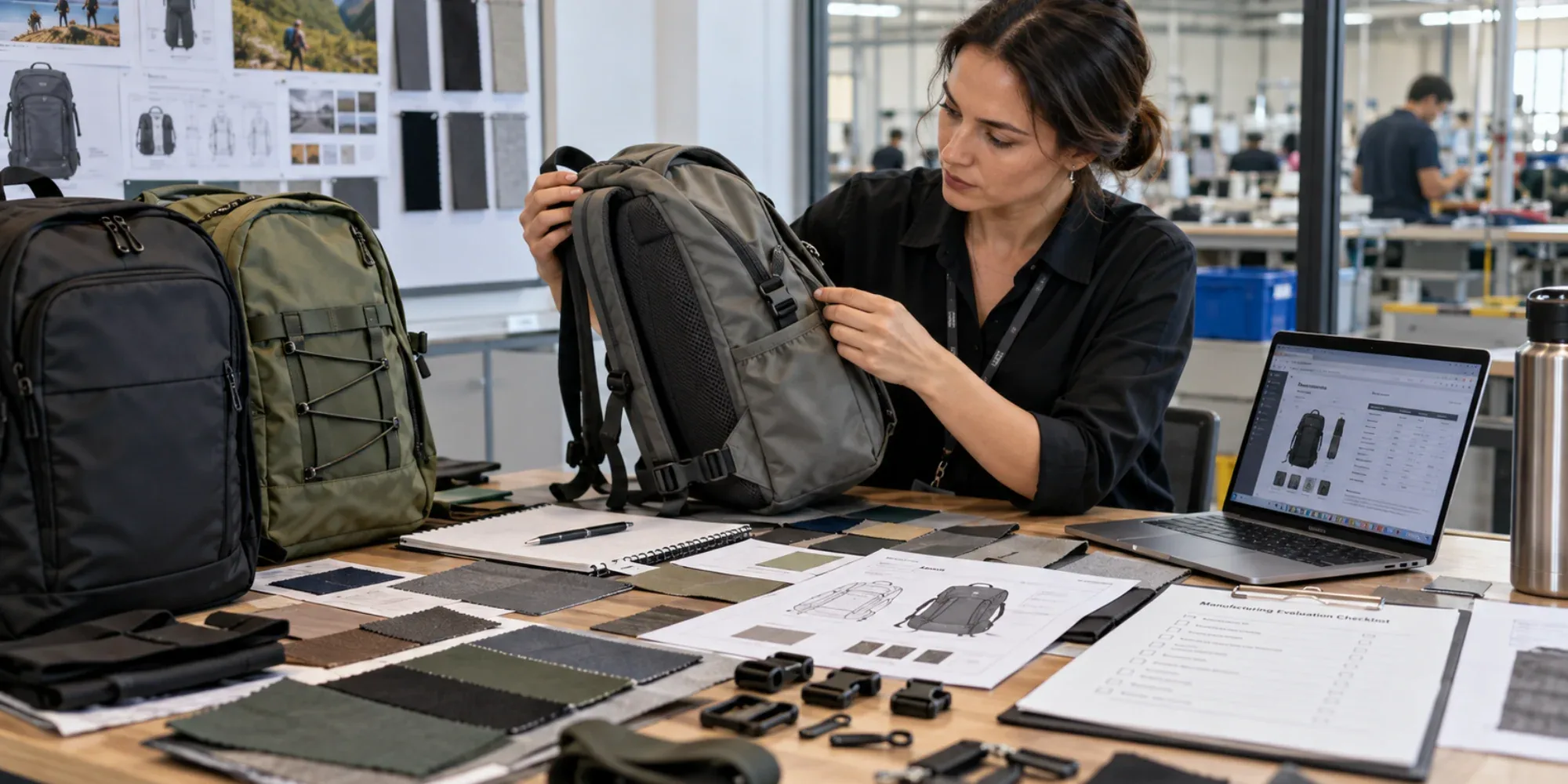
To verify a custom backpack manufacturer's reliability, buyers must look past website marketing and demand primary evidence: documented prototyping processes, recognized third-party audits, traceable material certifications, and detailed contractual agreements. A reliable manufacturer will readily provide recent quality control reports, verifiable facility credentials like ISO 9001, and a mutually confirmed 'golden sample' that serves as the binding standard for production.
Evaluating Sampling Procedures and Specification Accuracy
The first measurable test of a custom backpack manufacturer is their sampling procedure. Before committing to a large production run, buyers rely on physical prototypes to evaluate whether a facility can accurately interpret a technical pack. A reliable facility does not merely say yes to every design requirement; they provide documented feedback on manufacturing feasibility. This initial exchange tests the factory's pattern-making capabilities and their supply chain access for the required textiles, foam padding, and hardware. Instead of accepting generic assurances, sourcing managers should demand written records detailing the intended construction methods.
- A counter-sample accompanied by a detailed bill of materials that explicitly matches or corrects the buyer's original technical specifications.
- Redline documentation explaining any deviations from the original design, such as substituting a specific zipper gauge or altering a seam allowance to improve structural integrity.
- Physical fabric and hardware swatches attached to the prototype to confirm exact colorways, denier counts, and material weights before the final production fabric is ordered.
When an initial prototype arrives, the manufacturer's reliability is demonstrated by how they handle corrections and refine the physical product. A trustworthy facility requires the buyer to document approval or requested changes in a formalized feedback sheet. If a design includes complex features, such as suspended laptop sleeves, specialized bartack stitching at high-stress points, or waterproof welded seams, the factory should highlight any potential mass-production risks during this phase. If a manufacturer promises rapid turnaround without addressing the structural limits of the chosen materials, buyers risk receiving prototypes that cannot be replicated at scale without facing severe defect rates.
Sourcing managers must verify that the factory handles the core prototyping steps in-house rather than outsourcing the pattern creation. Facilities with direct control over their custom operations typically maintain a dedicated sampling room, allowing them to produce structural prototypes within a predictable timeframe. When checking a manufacturer's claims, inquire about their standard sampling timeline and whether they rely on external vendors for primary pattern drafting. Prolonged delays during this stage often indicate a lack of direct control over the manufacturing floor or difficulty sourcing the requested base materials. For company-specific information, see GFBags.
The culmination of the sampling process is the production of a golden sample. This finalized prototype acts as the binding physical contract for mass production. It must be identical to what will come off the assembly line, using the actual production fabrics, standard hardware, cushioning EVA foam densities for shoulder straps, and final branding applications like embroidery or heat transfers. A rigorous manufacturer will retain an identical counterpart to this approved sample on their factory floor, signed and dated by both parties. This dual-retention system prevents disputes over material substitutions or dimensional changes, such as strap length tolerances, once mass manufacturing begins.
Buyers frequently face a tradeoff between rapid prototype delivery and exact material matching. For the initial structural review, a factory might use available stock fabric in an incorrect color to quickly verify dimensions, pocket placement, and load distribution. While this accelerates the timeline, a buyer checking for manufacturer reliability must ensure that a final pre-production sample is eventually constructed using the exact dyed textiles and custom-molded hardware specified in the purchase order. Accepting a structural-only sample as the final golden sample removes the buyer's leverage if the mass-produced units exhibit color bleeding, incorrect fabric drape, or hardware malfunctions under heavy load.
Quality Control Records and Defect Tolerances
Once the golden sample is approved, the sourcing risk shifts from design interpretation to mass production consistency. A reliable custom backpack manufacturer will not simply offer verbal assurances of high-quality craftsmanship. Instead, they provide tangible evidence of their quality control framework. Sourcing managers must evaluate this framework by reviewing documented inspection protocols and historical quality control records before issuing a purchase order. Trust is established when a factory demonstrates exactly how they measure conformity across hundreds or thousands of identical units, identifying and rectifying errors before the bags ever leave the facility.
The foundation of verifiable production quality is the establishment of measurable defect tolerances, commonly implemented through an Acceptable Quality Limit standard. Buyers should not expect a zero-defect rate in soft goods manufacturing, as textile assembly involves varying fabric tensions and relies heavily on manual sewing operations. Instead, a trustworthy manufacturer will collaborate with the buyer to define specific thresholds for critical, major, and minor defects. For example, a minor defect might be a slightly irregular interior seam allowance or a loose thread tail that does not impact function. A major defect could be a misaligned main zipper, incorrect color matching on webbing, or missed bartack stitching on a load-bearing shoulder strap. Critical defects involve safety hazards, such as broken needles left inside the lining. Setting precise tolerances provides a clear, objective baseline for accepting or rejecting a production batch, removing subjective arguments over what is acceptable.
When evaluating a factory's quality management capabilities, buyers should request examples of standard inspection documentation to see what data is actually recorded. A robust quality control report for backpack production should explicitly detail several key metrics.
- Dimensional checks comparing the final assembled bags against the approved technical pack measurements.
- Visual inspection tallies categorizing identified defects according to the agreed upon tolerance thresholds.
- Dynamic load testing results on completed handles and strap assemblies, keeping in mind that component-level data like zipper cycle tests should be requested separately from raw material supplier research and development reports.
- Corrective actions taken by the production floor when an inspection reveals a spike in assembly errors.
Relying solely on final inspections introduces significant timeline and financial risks. If a factory waits until the entire backpack production run is completed and packaged before conducting quality checks, discovering a systemic error means the entire batch must be reworked or scrapped. If an incorrect needle gauge causes micro-tears in waterproof canvas, finding this out at final inspection is disastrous. Sourcing managers should look for evidence of routine in-line quality control. In-line inspections occur at various stages of the assembly process, such as immediately after raw material cutting, during logo application, or during the attachment of complex sub-assemblies. A manufacturer that actively generates in-line inspection reports demonstrates proactive process control. This approach allows floor managers to adjust sewing machine tension, recalibrate cutting tools, or retrain operators before a minor aesthetic error multiplies across the entire purchase order.
Reviewing these inspection reports gives buyers a transparent view of day-to-day operations and management rigor. If a manufacturer refuses to share redacted quality records from previous production runs, or claims they never experience defects, this is a warning sign of an immature facility. Buyers must actively seek out partners who treat quality control as a documented, statistical process rather than relying on a generic marketing promise. Systematically verifying these measurement capabilities upfront prevents post-shipment disputes over structural failures, dimensional inconsistencies, or material flaws. For company-specific information, see GFBags.
Verifying Third-Party Factory Audits
Many custom backpack manufacturers display quality management badges or social compliance logos on their websites to signal operational reliability. However, a digital logo is marketing material, not verifiable evidence. To establish genuine trust and reduce the need for constant on-site inspections, sourcing managers must request the underlying third-party certificates and full audit reports, then independently verify their authenticity. A supplier's willingness to share these documents transparently serves as an early indicator of their professional maturity. Relying solely on a webpage graphic leaves buyers vulnerable to facilities that lack valid credentials.
When evaluating credentials, buyers should look beyond the simple fact that an audit occurred. A certificate indicates that a baseline standard was met on a specific date, but the detailed audit report provides a more realistic view of daily factory operations. Minor non-conformances are standard in genuine manufacturing environments; what matters is how the facility addresses them. Requesting the corrective action plan allows buyers to see whether the factory actively improves its processes or merely treats audits as static paperwork exercises.
- Current Validity Dates: Ensure the certificate is active and note when the next renewal audit is scheduled. An expired certificate offers no reliable assurance of present-day factory conditions.
- Matching Facility Scope: The physical address on the audit must exactly match the facility producing the backpacks. A common pitfall is accepting a certificate held by a parent company while actual sewing operations are subcontracted to an un-audited location.
- Applicable Product Categories: Check the exact scope of the certification. A certificate for plastic injection molding does not validate the quality management system for soft goods or custom bag assembly.
- Issuing Body Accreditation: Confirm that the audit was performed by a recognized, independent certification body. Most legitimate registrars provide an online database where buyers can verify that the document has not been altered or revoked.
Different audits serve distinct purposes in the sourcing process, and buyers must request the correct evidence for their specific operational requirements. Quality management frameworks, such as ISO 9001, verify that a factory maintains formalized systems for calibrating measurement devices, maintaining production infrastructure, and managing general non-conformances. While these credentials do not guarantee a flawless backpack, they prove the factory has the infrastructure to achieve consistent output. Similarly, social compliance frameworks like amfori BSCI evaluate fair labor practices and workplace safety. Verifying these credentials is often a strict requirement to satisfy import regulations and corporate mandates.
| Audit Type | Primary Focus | Key Buyer Verification Step |
|---|---|---|
| Quality Management | Standardized operating procedures, calibration of measurement devices, and non-conformance management | Verify that the certification scope specifically covers soft goods, textiles, or bag manufacturing. |
| Social Compliance | Labor practices, workplace safety, working hours, and fair remuneration | Review the corrective action plan for severe safety or labor non-conformances. |
| Environmental Management | Waste handling, energy use, and pollution control | Check if the audit assesses raw material storage and textile waste disposal at the production site. |
By treating third-party audits as technical documents requiring independent verification rather than assumed guarantees, sourcing managers can reliably filter out manufacturers who exaggerate their capabilities. This rigorous verification helps buyers identify trustworthy partners with genuinely mature operational standards capable of supporting long-term production needs.
Substantiating Material and Sustainability Claims
When evaluating a custom backpack manufacturer, sourcing managers frequently encounter marketing highlighting eco-friendly fabrics and sustainable production methods. However, vague descriptions such as sustainable or ocean-bound plastic offer no concrete assurance of material authenticity. A reliable manufacturer understands professional buyers require documented traceability to support these claims, rather than generalized promises. Buyers must systematically verify that the specific textiles, foams, and hardware used in their production run match the exact environmental and performance specifications agreed upon during the prototyping phase. Without tangible proof, a brand risks non-compliance with regional sustainability standards.
The most effective way to substantiate material claims is through recognized third-party certifications that audit the supply chain. For recycled textiles, buyers should look for established programs tracking materials from source to final product. For example, according to its documentation, SCS Global Services launched the first third-party certification program for recycled content claims in 1989. The organization notes that companies count on it to deliver comprehensive assessment and certification for recycled content in the market today. Relying on independent programs ensures materials actually contain the specified post-consumer waste, rather than trusting an unverified supplier description. Recycled Content Certification | ISO 14021 & SCS‑103 | SCS
When a manufacturer claims to use certified recycled materials, buyers must request the current certification documents and check the specific scope of the approval. The certificate must apply to the actual material batch being purchased and explicitly state the verified recycled content percentage. Furthermore, the SCS Recycled Content Certification provides a Private Label certification option available to customers of certified manufacturers, allowing the re-branding of certified products under the customer's own company name. This traceability provides a distinct market advantage, but requires the buyer to confirm the factory's chain of custody remains intact before mass production begins. Recycled Content Certification | ISO 14021 & SCS‑103 | SCS
Thorough material verification becomes critical when a brand intends to sell backpacks into highly regulated markets. Regions with strict environmental rules demand exact proof of material origins. When assessing these requirements, buyers can consult regulatory resources; for instance, the official website for the European Commission may support organization-controlled statements and publications directly relevant to EU textile consumption data. Understanding this data helps sourcing managers gauge regional compliance strategies. If a manufacturer cannot provide traceable certificates for the textiles they procure, they introduce severe compliance risks for any buyer importing goods into these restrictive jurisdictions. European Commission, official website
Buyers must carefully weigh the practical tradeoffs between verified material sustainability and overall production costs. Procuring textiles with fully traceable, third-party audited recycled content typically carries a financial premium over standard virgin materials due to the rigorous chain of custody and laboratory testing required. If a brand distributes products in a market without strict environmental mandates, the buyer might choose to prioritize immediate physical durability and lower raw material costs instead of paying for certified traceability. However, opting for uncertified materials restricts the ability to market the product as sustainable and limits expansion into territories that monitor material inputs.
- Request the actual third-party material certificates from the facility rather than accepting a factory's summarized marketing claims or digital badges.
- Cross-reference the specific batch numbers on the provided certificates with the raw materials purchased for the current production run.
- Confirm the precise percentage of recycled content formally verified by the independent certifying body.
- Ask the manufacturer for independent lab test reports validating both the physical performance characteristics and the chemical safety of the sustainable textiles.
Beyond sustainability, material substantiation also applies to functional performance claims. If a backpack is marketed as highly waterproof or exceptionally abrasion-resistant, the manufacturer should produce standardized testing reports from accredited laboratories. These reports measure metrics such as hydrostatic head ratings for polyurethane coatings or the Martindale test for fabric surface wear. A trustworthy factory secures objective data to prove the material meets technical requirements, rather than relying solely on verbal assurances from their fabric suppliers.
Ultimately, all verified material specifications and sustainability certificates must be integrated into the final manufacturing contract. The exact denier count, coating type, recycled percentage, and certifying body should be explicitly listed alongside the physical golden sample. By formalizing these precise technical requirements in writing, sourcing managers protect themselves against unauthorized material substitutions during mass production. This contractual accountability ensures that the raw materials delivered in the final shipment exactly match the verified claims established during the initial supplier evaluation.
Assessing Production Capacity and Order Feasibility
A manufacturer's stated annual capacity is a common marketing metric, but buyers must verify it against physical and operational realities. Trustworthy suppliers provide tangible evidence of their production scale rather than simply promising they can handle any volume. When evaluating a custom backpack manufacturer, sourcing managers must systematically check that the facility's actual throughput aligns with the buyer's delivery timeline. Failing to verify production capability often results in a factory accepting an order they cannot fulfill internally, leading to severe delays or unauthorized subcontracting to unvetted, lower-tier facilities.
To substantiate capacity claims, buyers should add equipment lists and workforce data to their verification checklist. A reliable factory maintains an updated inventory of its specialized machinery, including programmable bartack machines, heavy-duty walking foot sewing machines, automated cutting tables, and heat-sealing equipment for waterproof bags. By comparing this machinery count against the facility's active workforce headcount and floor plan layout, buyers can estimate approximate production capacity. For example, if a manufacturer claims the ability to produce hundreds of thousands of complex technical backpacks monthly but only staffs fifty active sewing stations, the operational mathematics strongly suggest a reliance on outside contractors.
Minimum order requirements serve as another critical indicator of a manufacturer's operational structure and reliability. These minimums are not arbitrary numbers designed solely to maximize revenue; they reflect a factory's setup costs, production line efficiency, and raw material sourcing constraints. A facility optimized for massive, continuous production runs naturally requires higher minimums to offset the downtime of retooling lines for new designs. Conversely, a factory engineered for flexible changeovers might offer lower minimums but typically charges a higher per-unit cost. Buyers can evaluate this operational fit by checking several specific planning documents.
- A generic or redacted master production schedule to observe how a new order is slotted alongside existing client commitments.
- Raw material minimums, since the factory's required order size is often dictated directly by what their fabric mills require to dye custom textile batches.
- Detailed lead-time breakdowns that explicitly separate material transit, cutting, sub-assembly, final stitching, and packaging phases.
Buyers frequently encounter a tradeoff between negotiating smaller initial orders and securing reliable factory prioritization. Pushing a high-volume manufacturer to accept an order significantly below their standard requirements introduces substantial risk. To accommodate an undersized run, the factory might substitute the requested textiles with leftover stock fabric, rush the assembly line to get back to their primary clients, or repeatedly delay the order until a gap appears in their schedule. If a sourcing manager's purchasing volume does not align with the manufacturer's core business model, the partnership is unlikely to yield consistent quality or timely deliveries.
Finally, assessing order feasibility requires factoring in seasonal industry fluctuations. The backpack manufacturing cycle routinely experiences severe bottlenecks ahead of major retail events, such as back-to-school seasons or holiday shopping peaks. A trustworthy manufacturing partner will transparently communicate capacity constraints and provide accurate lead-time extensions during these predictable surges. Rather than accepting a blanket promise of a rapid turnaround year-round, buyers should request historical delivery performance data or standard operating procedures for managing peak-season production. Documented capacity planning demonstrates that the factory relies on organized scheduling rather than last-minute overtime to meet contract deadlines.
Contractual Accountability and Warranty Documentation
The final measure of a custom backpack manufacturer's trustworthiness is their willingness to codify prior agreements into a formal manufacturing contract. After evaluating sampling procedures, quality control records, and third-party audits, a sourcing manager must legally bind these elements together. Verbal assurances do not provide adequate protection if mass production deviates from expectations. A reliable facility expects rigorous documentation, recognizing that clear terms prevent costly misunderstandings. Buyers should view the contract as an essential operational checklist confirming that the manufacturer shares the exact technical understanding before bulk raw materials are purchased.
The cornerstone of contractual accountability is integrating the golden sample and its technical datasheet directly into the purchase agreement. The contract must explicitly reference this mutually approved prototype. It is insufficient for an agreement to simply state that the factory will produce bags as sampled. The finalized documentation must include a comprehensive bill of materials specifying the exact denier count of the exterior fabrics, the specific supplier for hardware like zippers, and the agreed-upon thread gauge. Formalizing these precise specifications ensures the buyer has clear recourse if the factory attempts to substitute non-compliant materials during bulk manufacturing to increase margins. To guarantee accountability, the contract should include several critical provisions.
- An explicit reference to the signed and dated golden sample retained by both the buyer and the factory.
- The mutually agreed Acceptable Quality Limit standards, outlining exact numerical thresholds for minor, major, and critical defects.
- A defined production and shipping timeline, accompanied by clear penalty clauses for unapproved delays.
- Detailed packing and labeling requirements to ensure the finished backpacks arrive properly sorted and ready for immediate deployment.
Warranty documentation provides another critical layer of evidence regarding a manufacturer's reliability. Buyers should require a written policy defining the scope of coverage for manufacturing defects, such as faulty bartack stitching or defective hardware installation. A transparent factory specifies the warranty duration and outlines the remedy process if end-users experience failures. Crucially, sourcing managers must understand the strict tradeoff between component costs and product longevity. If a buyer wants the product to endure a multi-year lifespan to support a long warranty, they must specify and pay for premium materials. A factory cannot guarantee an extended lifespan if the buyer insists on purchasing the lowest-cost standard fabrics.
Ultimately, the true test of contractual accountability occurs when production discrepancies arise. If a completed batch fails the final inspection and exceeds the documented defect tolerances, the contract must dictate the exact resolution. Trustworthy manufacturers will agree to documented terms that require them to rework, replace, or discount the defective units before the final payment is released. If a supplier refuses to sign a purchase agreement containing detailed material specifications, strict quality thresholds, and clear warranty terms, buyers should consider this a definitive warning sign, regardless of how impressive the initial prototype appeared.