 Skip to content
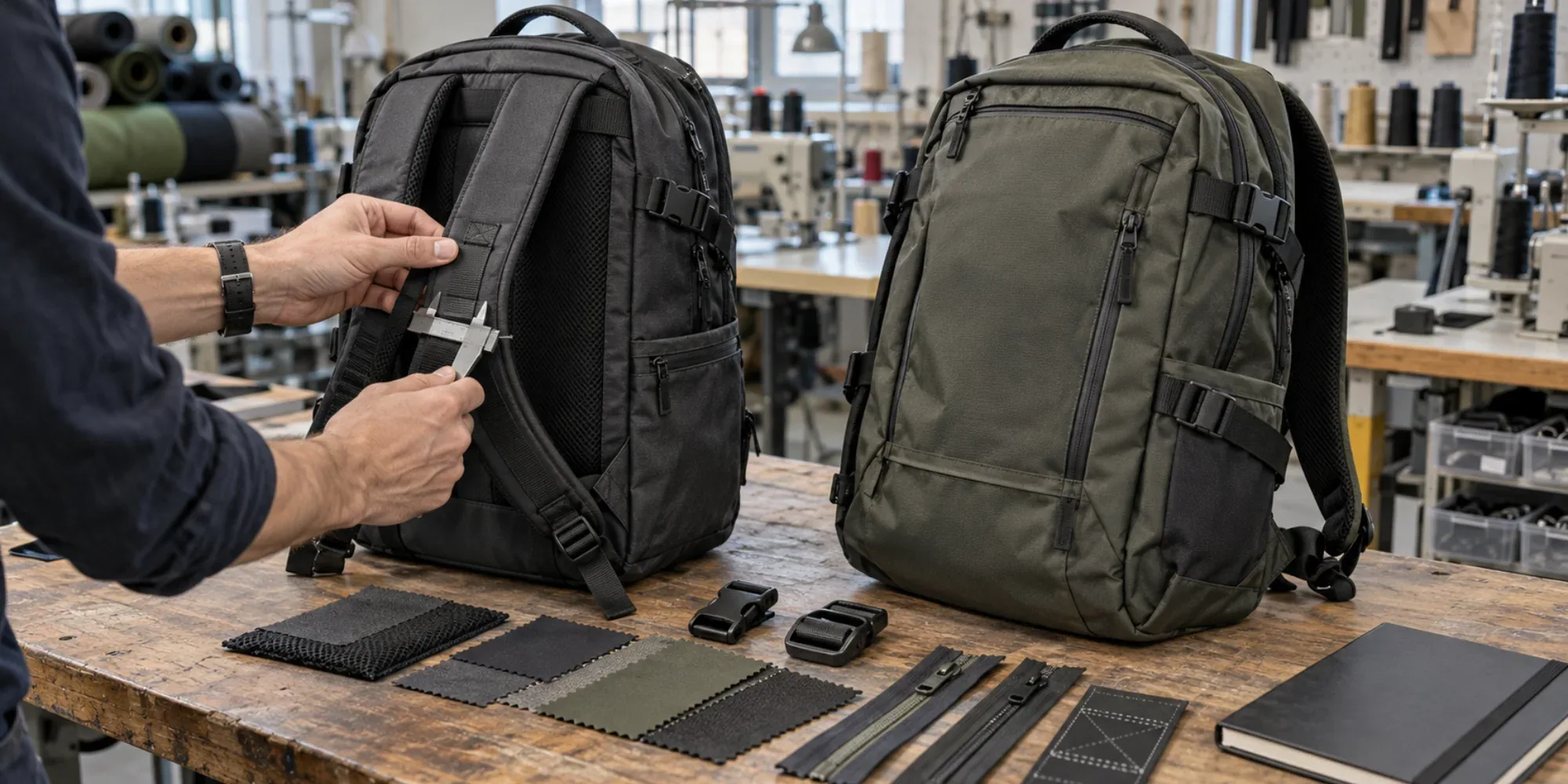
To evaluate and choose a custom backpack manufacturer, sourcing managers must compare suppliers based on their sampling accuracy, documented quality control procedures, and ability to substantiate material claims. A sound decision prioritizes a manufacturer's proven capacity to replicate approved prototypes consistently and verify compliance through third-party certifications, rather than relying solely on the lowest quoted unit price.
Evaluating Sampling Capabilities and Prototype Accuracy
A manufacturer's general portfolio only demonstrates what they achieved with previous clients, often after multiple revisions and established relationships. For a buyer evaluating a new supplier, the initial sampling phase serves as a critical stress test of technical competence. The primary question a sourcing manager must answer is not whether the factory can sew a generic bag, but whether they can accurately translate a specific set of bespoke requirements into a physical prototype without excessive hand-holding. This phase reveals the true operational baseline of the supplier.
The evaluation begins the moment a technical specification package, or tech pack, is submitted. Buyers must observe how the supplier processes this documentation. A proficient manufacturer will systematically review the bill of materials, dimensional tolerances, and construction notes, returning with highly specific questions. If a supplier accepts a complex tech pack without a single clarification regarding seam allowances, bartack placements, or hardware sourcing, this often signals a lack of thorough review rather than exceptional technical confidence. Buyers should assess whether the factory technical team understands the functional intent behind the design.
- Do they ask for clarification on unspecified material weights or coatings?
- Can they identify potential failure points in the requested strap reinforcement?
- Do they understand why a laptop compartment requires suspended bottom padding?
- Are they confirming the exact grade of zippers and sliders required?
Another crucial decision criterion is the supplier approach to manufacturing challenges. Custom backpack designs often include elements that look aesthetically pleasing on paper but are difficult to execute at scale. A reliable manufacturer acts as a technical partner, identifying potential assembly issues before cutting any fabric. Buyers should observe how the supplier communicates these constraints. Do they propose viable alternatives that maintain the design intent while improving manufacturing efficiency or long-term durability? The ability to flag a potential failure point, such as a zipper curvature that is too tight or a fabric choice that will fray under stress, demonstrates practical manufacturing expertise rather than mere order-taking.
When navigating these technical discussions, it helps to understand the supplier framework for bespoke projects. For instance, reviewing a Custom Service workflow can clarify their standard operating procedures for pattern making, raw material sourcing, and prototype iterations. Buyers should ask how many revision rounds are typical for their product complexity and what the standard lead time is for a first-fit prototype. This establishes a baseline for comparing responsiveness and structural organization across different candidates. For company-specific information, see GFBags.
Once the physical sample arrives, the comparison shifts from communication to execution. Buyers must evaluate the prototype against the original tech pack, not just for general aesthetic appeal. Decision questions here include checking if the overall dimensions fall within the specified tolerances and whether the stitching is straight, consistent in stitch length, and properly finished at the ends. Buyers must examine hidden areas, such as the binding on internal seams and the reinforcement at high-stress points like the top grab handle and shoulder strap attachments. A manufacturer that cuts corners on the internal finishing of a prototype, where they know the buyer will inspect it, will almost certainly do so during bulk production.
A common issue during the sampling phase is unauthorized material substitution. Buyers must ask if the supplier used the exact materials specified or if they substituted similar but inferior alternatives. While it is normal for a factory to use available stock materials for an initial fit and proportion sample, any substitutions must be explicitly communicated and approved beforehand. If a prototype arrives with unauthorized hardware changes, a lower-denier fabric than requested, or a different foam density in the back panel, this indicates a breakdown in control or a willingness to bypass strict requirements. Assessing this behavior early prevents costly disputes during bulk manufacturing.
Finally, buyers must evaluate if the prototype is optimized for bulk production. A beautifully crafted sample hand-sewn by a single master technician is useless if the factory floor cannot replicate it efficiently. Sourcing managers should ask the supplier to provide a breakdown of any specialized machinery, custom jigs, or proprietary molds required for the final product. Understanding the tooling requirements and the factory capacity to scale the prototype specific construction methods ensures that the sample is not just a theoretical exercise, but a reliable blueprint for the final commercial production run.
Verifying Material Sourcing and Sustainability Claims
When comparing custom backpack manufacturers, one of the most critical decision criteria is how a supplier handles raw material sourcing, particularly regarding sustainability claims. Buyers face a manufacturing landscape where terms like eco-friendly and recycled are frequently used as generic marketing tools rather than precise technical specifications. A manufacturer offering a lower unit price on a supposedly sustainable backpack may simply be utilizing unverified fabrics. Therefore, sourcing managers must base their evaluation on a supplier's ability to provide documented evidence of their material supply chain, ensuring that the physical product matches the ethical and environmental claims intended for the end consumer.
The primary decision question a buyer must ask is whether the supplier can provide a verifiable chain of custody for all claimed materials. If a manufacturer states that a backpack uses recycled polyester or nylon, they should be able to produce transaction certificates that trace the raw material from the recycling facility to the textile mill, and finally to the assembly floor. Without these documents, the buyer absorbs the risk of false advertising. A proficient supplier will proactively include these documentation steps in their standard operating procedures, whereas a disorganized factory will struggle to produce the necessary paperwork or offer excuses about supplier confidentiality.
To mitigate sourcing risks, buyers must require suppliers to substantiate their recycled content claims through recognized third-party certification bodies. For example, SCS Global Services provides comprehensive assessment and certification for recycled content in the market. When evaluating a manufacturer, buyers should verify if the facility holds or can source materials backed by such authorities. Furthermore, if a buyer intends to market these products under their own brand, they must determine how the certification applies to the finished goods. SCS Global Services allows customers of certified manufacturers to utilize a private label certification, which permits the re-branding of the certified products under the customer's own company name. Confirming this capability during the supplier comparison phase ensures that the final brand owner can legally and accurately display the recycled credentials. Recycled Content Certification | ISO 14021 & SCS‑103 | SCS
- Can the supplier provide traceable transaction certificates for all recycled textiles prior to bulk production?
- Does the manufacturer support private label rebranding under recognized third-party certification frameworks?
- How does the facility isolate and verify incoming certified raw materials to prevent mixing with standard stock?
- Are material substitutions explicitly prohibited without prior written authorization?
Evaluating material sourcing must extend beyond the primary exterior fabric. A custom backpack is a complex assembly of webbing, spacer mesh, closed-cell foam padding, zippers, and structural inserts. Suppliers often label a product as recycled when only the main body fabric contains recycled fibers, while the internal linings, shoulder straps, and plastic hardware remain standard virgin materials. A rigorous supplier comparison requires asking for a component-by-component breakdown. Sourcing managers must ask what exact percentage of the total backpack weight is composed of certified recycled materials. A transparent manufacturer will separate the certified sustainable components from the standard components in their quotation, providing a clear picture of what the buyer is actually purchasing.
Hardware sourcing serves as another vital comparison point. Backpack components such as acetal buckles, tension locks, and zinc alloy zipper pulls typically originate from different supply chains than the textiles. Buyers must compare whether a manufacturer relies on open wholesale markets for these elements or if they maintain established relationships with specific, vetted hardware vendors. Checking the sourcing origin of hardware is essential because poor quality buckles are a primary point of failure in load-bearing bags. Verifying the material composition and load capacity of these small parts prevents unexpected breakage and costly returns.
Finally, buyers must assess how a supplier manages the specific procurement timelines associated with certified materials. Sourcing sustainable textiles often extends lead times compared to utilizing off the shelf virgin fabrics. Custom dyed recycled textiles typically require distinct minimum order volumes dictated by the textile mill, not the assembly factory. When comparing different manufacturers, buyers must ask how each facility handles these constraints. Do they hold a strategic stock of common certified materials, or must they order fresh fabric for every production run? Understanding this workflow allows the sourcing manager to accurately map out the production schedule. Evaluating these operational details ensures the chosen supplier can balance sustainability requirements with realistic production schedules. For company-specific information, see GFBags.
Comparing Quality Control Protocols and Batch Consistency
A successful sampling phase confirms a supplier's technical ability, but bulk production tests their operational discipline. When evaluating a custom backpack manufacturer, sourcing managers must look beyond the initial prototype to verify the factory's quality control infrastructure. The critical decision question shifts from whether the supplier can make one perfect bag to how they guarantee the five-hundredth bag matches the approved sample. Comparing manufacturers requires examining their documented inspection protocols rather than accepting vague assurances about high quality or generic promises of rigorous oversight.
Effective quality control begins before the assembly line starts. Buyers should inquire about the manufacturer's incoming material inspection procedures. Before cutting fabric for a custom backpack order, reliable suppliers test raw materials for color consistency, fabric flaws, and hardware functionality. If a factory relies entirely on final inspections, any defect introduced during the cutting or early sewing stages becomes embedded in the finished product, leading to higher defect rates and delayed shipments. Sourcing managers should ask if the supplier uses a documented defect tracking system for incoming materials to catch these issues before assembly.
- Do you conduct regular During Production inspections, and at what completion stages do they occur?
- Are raw materials and custom hardware inspected against the approved specifications before the cutting phase?
- How is the approved prototype utilized on the factory floor during the assembly process?
- Do you maintain a dedicated quality control team independent of the production line supervisors?
A major comparison criterion is the manufacturer's adherence to Acceptable Quality Limit standards. Sourcing managers must define the specific tolerances for critical, major, and minor defects before signing a contract. For custom backpacks, buyers often require an Acceptable Quality Limit of 2.5 for major defects, such as broken zippers or open seams, and 4.0 for minor defects, like untrimmed threads. Sourcing managers should explicitly ask prospective suppliers what default inspection standard they apply and what their corrective action plan entails if a production batch fails an internal evaluation. A supplier unwilling to agree to standard threshold terms presents a significant operational risk.
Beyond internal protocols, a buyer must evaluate a supplier's willingness to accommodate independent verification. Reputable manufacturers expect and welcome third-party quality control audits. Sourcing managers should ask if the factory has standard operating procedures for integrating external inspectors during the production run or prior to shipment. Evaluating how a supplier manages these external audits reveals their transparency; a manufacturer that restricts inspector access to specific production lines or delays scheduling final inspections often lacks confidence in their own batch consistency.
Backpack manufacturing requires managing specific variance limits. Textile products inherently involve some degree of dimensional variance, but sourcing managers must determine what a supplier considers an acceptable deviation. Buyers should compare how manufacturers handle tolerances for stitch length, commonly measured in stitches per inch, as well as alignment requirements for heavy-stress components. In custom backpacks, a shoulder strap attached slightly off-center drastically affects the user's load distribution and overall comfort. Establishing these measurable tolerances allows the buyer to enforce objective construction standards rather than debating subjective quality claims after the products are finished.
Another crucial variance to evaluate is color consistency across different material batches. Custom backpacks often utilize multiple fabric panels, synthetic webbing, and plastic hardware components that must visually match. Sourcing managers should ask suppliers how they manage color consistency, particularly when these components are sourced from different secondary suppliers. Reliable manufacturers often evaluate material swatches under standardized lighting conditions to measure deviation. Comparing how suppliers address these granular material details provides a clear picture of their overall supply chain management maturity.
Finally, buyers must assess how the manufacturer utilizes the approved reference model, often referred to as the golden sample. A dependable supplier does not just store the approved prototype in an administrative office; they use it as a functional reference on the production floor. Sourcing managers should ask if the factory creates duplicate sealed reference samples for the production line leaders and quality control inspectors. The presence of a rigorously maintained reference system ensures that the workers actually sewing the bags have a physical benchmark to check their work against, minimizing structural drift over the course of a long production run.
Assessing Minimum Order Quantities and Production Scalability
Assessing a custom backpack manufacturer requires evaluating both accessible entry volumes and long-term production scalability. Buyers often focus on finding a Minimum Order Quantity that limits initial capital tie-up, but evaluating a supplier solely on low minimums introduces operational risk. The critical decision criteria involves verifying whether the facility handling a small initial run possesses the infrastructure, labor force, and machinery to absorb future growth without compromising lead times or assembly standards.
Sourcing managers must ask how the supplier structures their minimums, as production thresholds are rarely a single fixed number. Suppliers typically separate minimums into an order quantity per style and a quantity per colorway. Buyers must determine whether these minimums are dictated by the factory's assembly line efficiency or by their raw material suppliers. Utilizing stock fabrics often allows a manufacturer to accept a lower-volume order, whereas specifying custom-dyed textiles or proprietary waterproof coatings usually triggers higher minimums mandated by the textile mill. Identifying this constraint helps buyers adjust technical designs to meet volume limits.
- What is the standard minimum order quantity per backpack design and per specific colorway?
- Are surcharges applied for production runs below the standard minimum, and how do they alter the target unit cost?
- Does the manufacturer rely on stock materials to achieve lower minimums, or can they source custom fabrics at this tier?
- How much advance notice is required to scale production volumes by double or triple the initial order?
- What percentage of the facility's total monthly capacity is currently committed to existing clients?
Scalability requires an assessment of physical factory capacity. A manufacturer eager to secure a new account might accept a small initial trial, but buyers must evaluate their actual production ceiling. If demand spikes and the buyer needs substantially higher volumes, a facility lacking sufficient sewing lines, automated cutting equipment, or warehouse space will struggle to deliver. When a factory's internal capacity is exceeded, managers often resort to unauthorized subcontracting. Pushing excess volume to unvetted secondary workshops introduces severe quality control variations and nullifies any compliance audits previously performed on the primary facility.
Lead time stability serves as another fundamental comparison metric. Buyers must ask how the supplier manages production schedules during peak manufacturing periods. A smaller buyer might experience sudden lead time extensions if a supplier deprioritizes their production run in favor of a larger, established client. Evaluating a supplier's overall capacity utilization provides insight into whether they possess the operational buffer to handle volume fluctuations or if their existing production lines are already operating at maximum output.
Buyers must also account for the volume requirements of custom hardware. Backpacks frequently feature branded zipper pulls, custom buckles, or molded back panels that require specific tooling. The manufacturing minimums for these individual components routinely exceed the assembly minimums for the finished backpack. Sourcing managers must clarify who holds the financial liability for excess component inventory. Determining whether the buyer must purchase and store surplus hardware, or if the manufacturer amortizes that cost across future orders, is a decisive factor in evaluating the true cost of production scalability.
Aligning with Target Market Compliance and Regional Standards
Sourcing custom backpacks is not simply a matter of physical assembly; it requires ensuring the final product can legally enter and be sold within its intended destination market. A critical decision criterion during the supplier evaluation phase is the manufacturer's administrative capacity to support specific regional textile regulations. A beautifully constructed backpack quickly becomes a financial liability if it is held at customs due to missing compliance documentation or improper labeling. Therefore, buyers must treat a supplier's regulatory knowledge and documentation practices as equally important to their physical sewing capabilities.
The primary decision question a sourcing manager must ask is whether the prospective supplier understands the specific testing and material restrictions of the buyer's target regions. Different global markets enforce distinct rules regarding chemical restrictions, such as strict limits on azo dyes in fabrics, heavy metals in zippers and hardware, or phthalates in synthetic waterproof coatings. Comparing suppliers involves asking them to outline the specific testing protocols they rely on for highly regulated areas. A competent manufacturer will proactively recommend appropriate third-party laboratory tests during the initial quotation phase, rather than waiting for the buyer to dictate every individual chemical restriction.
Meeting regional standards often requires detailed reporting on the materials used. For example, bringing finished products into the EU requires importers to maintain comprehensive supply chain documentation. The European Commission provides official publications and statistics detailing EU textile consumption data, underscoring the administrative focus on tracking material footprints. To align with these regional standards, buyers must ensure their prospective suppliers can provide granular material breakdowns. A capable supplier must demonstrate that they can accurately track raw material origins and consumption rates per production batch, equipping the buyer with the exact data needed to address regulatory expectations. European Commission, official website
Administrative compliance relies heavily on a factory's internal documentation workflows. Sourcing managers should thoroughly question how a manufacturer archives test reports and compliance certificates. If a regulatory body audits a shipment months after production has concluded, the buyer must be able to retrieve the exact material safety data sheets and chemical compliance certificates corresponding to that specific batch. During the supplier comparison phase, buyers can request sample documentation from previous generic production runs to assess the clarity and organization of the factory's administrative records. A disorganized supplier that struggles to produce historical compliance data presents a high risk for future regulatory audits and supply chain disruptions.
- Can the supplier provide historical examples of passing third-party chemical tests relevant to the destination market?
- How does the facility track and archive material safety data sheets for synthetic coatings, dyes, and adhesives?
- Is the administrative team capable of producing the detailed textile consumption data required by regional reporting frameworks?
- Does the manufacturer maintain established relationships with accredited testing laboratories for pre-shipment compliance verification?
Beyond chemical testing and material reporting, physical labeling requirements vary significantly by geographic region. Buyers must evaluate whether the manufacturer has robust quality controls in place for applying the correct care labels, material content tags, and country of origin markings. Applying an incorrect care label, misstating the fiber composition percentages, or omitting a mandatory warning can result in immediate shipment rejection at the port of entry. Sourcing managers should ask how the supplier verifies label accuracy before the final stitching phase and how they handle regional variations if the buyer is distributing a single backpack model across multiple international markets simultaneously.
Ultimately, assessing a custom backpack supplier on compliance criteria tests their overall operational maturity. A manufacturer might offer competitive pricing and execute high-quality stitching on a prototype sample, but lacking the administrative infrastructure to support international textile regulations renders them unsuitable for global distribution. Sourcing managers must prioritize suppliers who view compliance documentation as a standard operating procedure rather than an optional administrative burden. By verifying a manufacturer's capacity to meet destination market standards early in the comparison process, buyers can protect their brand reputation, avoid costly border delays, and ensure a smooth flow of inventory.