 Skip to content

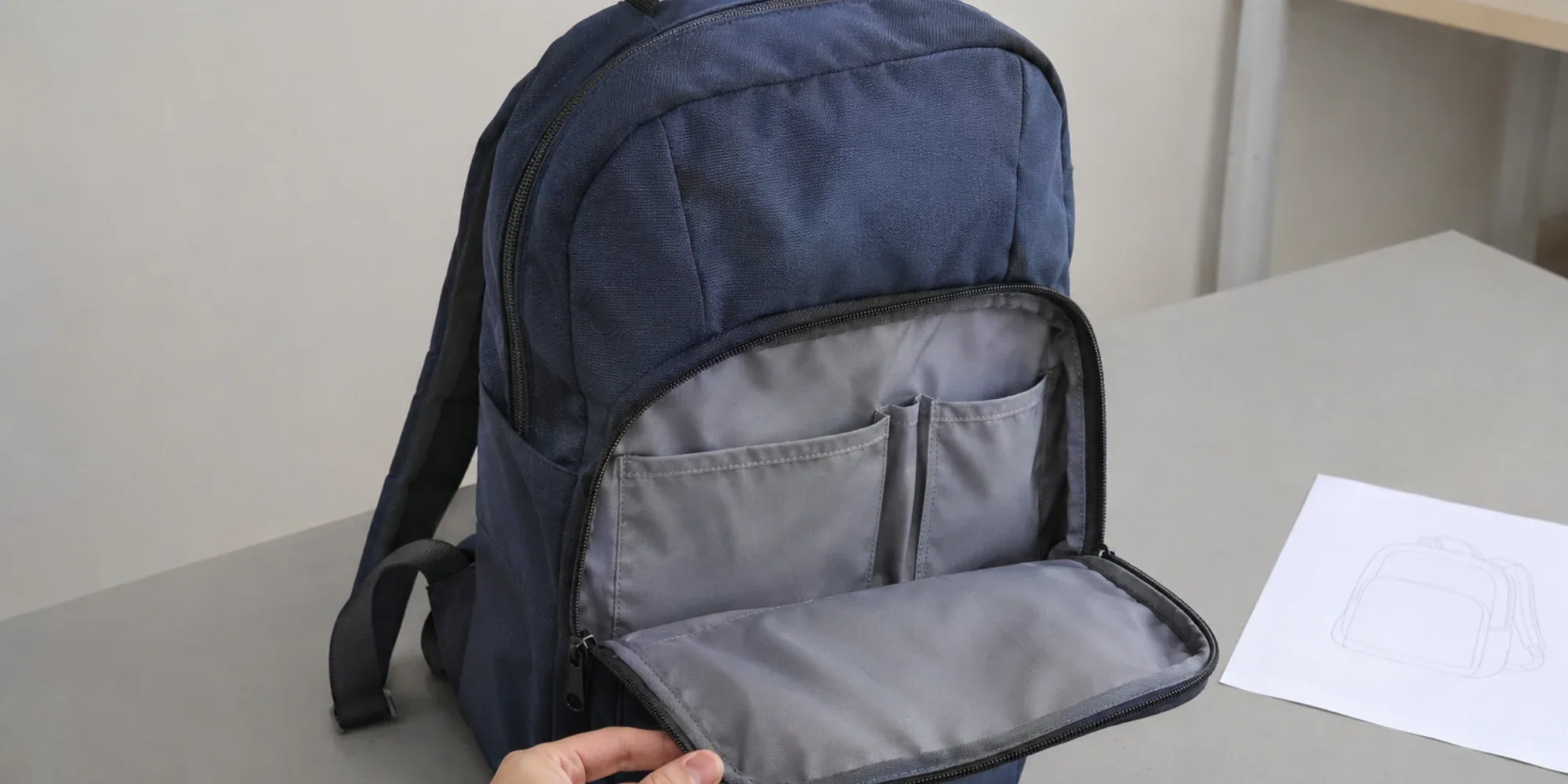
Implementing a commuting backpack with an OEM requires translating daily carry requirements into precise material specifications, verifying sustainability credentials through third-party certifiers, and establishing proactive defect reduction frameworks. Product developers must integrate Failure Mode and Effect Analysis (FMEA) and Statistical Quality Control (SQC) with their manufacturing partner, ensuring that lean production concepts manage assembly efficiency from the rapid sampling phase through to full-scale corporate or retail fulfillment.
Translating Commuter Requirements into OEM Specifications
A successful commuting backpack requires more than an attractive silhouette; it demands a rigorous translation of daily transit needs into precise manufacturing specifications. When moving from initial concept to production, product developers must establish comprehensive technical packages that leave no room for supplier ambiguity. Commuting bags face distinct environmental stresses, including constant abrasion against transit seating, exposure to sudden weather changes, and the repeated impact of being set on hard surfaces like concrete platforms. Sourcing managers must therefore define structural, material, and hardware constraints with exact measurements rather than relying on generic descriptions. When navigating a potential partner's Home page to check their company-specific information and general capabilities, developers should remember that these broad services must be firmly anchored by strict technical specifications before production begins. For company-specific information, see GFBags.
Hardware is often the primary failure point in daily carry items. A commuter might open and close the main compartment of their backpack dozens of times a day under varying levels of tension. If a specification sheet simply requests a standard nylon zipper, the manufacturer may source a low-cost alternative that ultimately derails the product's longevity. Instead, implementation guidelines should require components from established, standardized suppliers. For instance, developers often specify zippers from major manufacturers like SBS, noting that the company serves as the secretariat for the national hardware products standardization technical committee's zipper branch. Requiring hardware from entities that actively participate in defining industry standards helps ensure that the zipper teeth, sliders, and tape can withstand the continuous tension and lateral pull typical of an overstuffed commuting bag. sbszipper.com
Beyond external hardware, the internal structure of a commuting bag must actively protect expensive digital equipment like laptops and tablets while maintaining an upright, professional profile. A bag that sags or collapses when partially empty not only looks unprofessional but also fails to distribute weight ergonomically across the wearer's back. Sourcing managers should provide explicit instructions regarding padding density, compartmental geometry, and load-bearing reinforcements to ensure the final product meets these daily commuter expectations. Product developers should explicitly define several structural specifications in their initial manufacturing documents to avoid ambiguity during assembly.
- Suspended laptop sleeves: Specify a minimum clearance distance between the bottom of the laptop compartment and the base of the bag to prevent direct impact when the bag is dropped.
- High-density foam selection: Mandate closed-cell EVA foam rather than standard open-cell polyurethane foam for bottom panels and shoulder straps to ensure the padding resists compression over time.
- Reinforced stress points: Detail the exact bar-tack stitching patterns required at the shoulder strap attachments and haul handles to manage the heavy, concentrated loads of devices and documents.
Commuting backpacks are frequently utilized in corporate environments, making them prime candidates for B2B sales and employee distribution programs. Implementing an OEM partnership requires planning for these downstream applications during the initial specification phase. Specific studies evaluating B2B sales strategies within the corporate gifts sector have analyzed bag manufacturing, product customization, and the adoption of customer-centric approaches. If a brand intends to offer co-branded versions of the backpack to corporate clients, the technical documentation must designate specific customization zones. These unencumbered panels allow the facility to easily apply embroidery, heat transfers, or custom patches without interfering with structural seams, waterproof coatings, or internal pockets. Strategies for Effective B2B Sales in the Corporate Gifts Industry: Best Practices and Success Tactics in the w.r.t Bag Manufacturing in Ahmedabad City | International Journal of Business and Management Practices (IJBMP)
Finally, translating requirements means defining acceptable manufacturing tolerances for the finished goods. Because textile assembly inherently involves manual sewing and handling, slight variations between individual units are inevitable. An effective implementation guide must define the acceptable variance in overall bag dimensions, required stitch density measured in stitches per inch, and fabric color consistency across different dye lots. By establishing these hard metrics before the rapid sampling phase begins, sourcing managers protect the functional integrity of the commuting bag while providing the assembly partner with a clear, objective standard for quality control and final factory inspection.
Verifying Material Sourcing and Sustainability Claims
Modern commuting backpacks must balance intense daily physical wear with increasing market demands for verifiable environmental responsibility. When product developers specify recycled polyesters, nylon blends, or responsibly sourced leather accents, simply writing a generic request for eco-friendly fabric on a technical pack is insufficient for an original equipment manufacturer. Without strict definitions and rigorous documentation, brands risk receiving materials that fail to meet either structural standards or consumer-facing marketing claims. A successful manufacturing implementation requires sourcing managers to mandate specific, auditable third-party certifications from their production facilities. By treating environmental attributes with the same precision as physical dimensions, developers ensure the final commuting bag performs reliably under heavy loads. A commuter bag faces constant friction against transit seats, meaning any certified textile must still pass rigorous performance tests for abrasion resistance and tear strength.
For heavy-duty fabrics utilizing recycled plastics, brands must rely on established assessment programs to substantiate their material claims before integrating them into the assembly process. Sourcing managers should require documentation from recognized authorities rather than accepting a factory's internal assurances. For example, SCS Global Services introduced its initial third-party verification for recycled content in 1989 and continues to serve as a leading authority for comprehensive material assessments. If a brand intends to market a commuting bag under its own name using these specific credentials, they can leverage the SCS Recycled Content Private Label certification. This program is accessible to customers of certified manufacturers, enabling them to rebrand certified items under their own corporate identity. Instead of attempting to independently track raw materials through a supplier's sewing lines, sourcing managers can rely on this formalized private label structure to validate their public-facing claims. Recycled Content Certification | ISO 14021 & SCS‑103 | SCS
Commuting backpacks frequently incorporate leather for high-abrasion exterior zones, such as reinforced bottom panels, structural haul handles, and oversized zipper pulls. To ensure these critical trims meet environmental standards, developers should align their material specifications with the Leather Working Group. Formed in 2005 as a joint effort uniting apparel, footwear, and upholstery brands with leather producers, the Leather Working Group functions as an international non-profit, multi-stakeholder organization. It actively promotes the adoption of responsibly produced leather as a viable sustainable resource. By demanding certified hides in their supplier agreements, procurement teams verify that the tanneries supplying their manufacturing partner adhere to strict environmental compliance and responsible resource management. This protects the brand's reputation while maintaining the physical toughness needed for daily transit. What we do – Leather Working Group
- Scope Certificates: Verify active credentials during the initial sampling phase to confirm the facility is authorized to handle and process the specified certified materials.
- Transaction Certificates: Require official raw material documentation once bulk production materials ship, proving the exact fabric yardage matches the order requirements.
- Database Verification: Cross-reference the supplier's provided certification numbers against public registry databases maintained by certifying bodies to identify any expired or invalid credentials.
- Substitution Protocols: Define exact guidelines, strictly prohibiting the manufacturer from swapping certified fabrics for standard synthetic alternatives to resolve unexpected supply chain delays.
Implementing certified materials introduces distinct operational tradeoffs that sourcing managers must plan for early in the partnership. Certified recycled nylons and responsibly processed leathers generally command higher minimum order quantities and longer raw material lead times than conventional alternatives. A manufacturer might require an additional four to six weeks just to procure documented fabrics before bulk bag assembly can begin. Furthermore, smaller production runs may face disproportionately high surcharges because the factory must source custom-dyed certified fabrics in smaller batches. Consequently, procurement teams must align their broader project timelines with these extended sourcing windows. Buyers reviewing factory capabilities should specify their verification expectations immediately, ensuring the factory can support third-party material assessments before any prototyping agreements are signed. This prevents costly delays and guarantees verifiable data. For company-specific information, see GFBags.
Implementing Proactive Defect Reduction Strategies
Commuting backpacks are structurally complex, integrating padded laptop sleeves, weather-resistant exterior coatings, rigid internal frames, and heavy-duty hardware. This physical complexity introduces numerous potential failure points during cutting, sewing, and final assembly. Relying solely on final inspections at the end of the manufacturing line is inefficient and costly. These post-production checks primarily catch visible surface defects, such as a misaligned logo or a scuffed face panel, but they can easily miss hidden structural errors buried beneath the inner lining. By the time a finished backpack reaches this stage, unpicking seams to fix an internal error often ruins the surrounding technical fabric. Instead, product developers and sourcing managers need proactive frameworks that identify and mitigate specific assembly risks long before mass production begins.
Formalizing defect reduction requires structured methodologies rather than ad-hoc problem-solving on the factory floor. In industrial contexts, research has aimed to analyze bag quality by applying an integrated Statistical Quality Control and Failure Mode and Effect Analysis framework to determine prioritized corrective actions based on a calculated Risk Priority Number. While academics have utilized these specific frameworks to assess defects in basic products such as woven bags, the underlying methodology remains highly relevant to the multi-layered assembly processes required for complex commuting gear. By implementing these systems, sourcing managers establish a proactive defense against manufacturing inconsistencies. Integrated SQC and FMEA Framework for Woven Bag Defect Reduction In Manufacturing Industry | Academia Open
By utilizing Failure Mode and Effect Analysis, the brand and the manufacturing partner systematically map out every step of the assembly process to anticipate what could go wrong. The framework evaluates those three core factors for any potential manufacturing defect. For a daily commuting backpack, an undetected skipped stitch on an internal pen pocket might have a low severity rating and a low overall risk score, requiring no immediate intervention from the production manager. Conversely, a weak bar-tack on a main shoulder strap attachment point carries a very high severity rating. If that attachment fails while a commuter is running to catch a transit connection, the bag drops, potentially destroying an expensive laptop.
Sourcing managers should require their manufacturing partners to collaborate on this risk analysis document during the late prototyping and pre-production phases. The factory team brings practical insight into typical material variations, such as how sewing a specific coated nylon might cause needle overheating or lead to skipped stitches at high speeds. The product developer brings critical insights regarding user-end severity expectations and daily carry demands. Together, they review the high-risk items and establish preventative measures. If the strap attachment failure is identified as a critical risk, the corrective action might involve upgrading thread thickness, modifying the sewing pattern to add a reinforcing cross-stitch, or implementing a dedicated pull-test station for that specific operation.
The decision to implement a formal statistical quality control and failure analysis framework depends heavily on the production scale, the facility capabilities, and the complexity of the bag design. Rigorous statistical tracking requires time, specialized operator training, and significant administrative overhead from both the quality team and the supplier. For short promotional runs of basic unlined canvas totes, simple post-production visual inspections may suffice without requiring full failure analysis frameworks. However, multi-compartment commuting bags command higher retail price points, require long-term structural durability guarantees, and protect fragile electronics. These demanding use cases justify the upfront investment in formalized quality planning.
Once full-scale production begins, Statistical Quality Control provides ongoing empirical verification that the corrective actions established during the pre-production phase are actually working. This approach replaces subjective factory floor evaluations with data-driven, continuous monitoring. Rather than a line supervisor casually inspecting random finished bags for general appearance, statistical control dictates specific, mathematically determined sampling intervals and strict control limits for measurable attributes. For example, designated quality control staff might measure the seam allowance width on the main zipper installation, or count the exact stitches per inch on critical load-bearing seams at regular hourly intervals throughout the shift.
If the data from these statistical samples begins to drift toward the outer edges of the acceptable engineering limits, the factory can halt the line and proactively recalibrate sewing machines or retrain operators before any actual unusable defects are produced. This shifts the partnership from a reactive dynamic, where sourcing managers argue with suppliers over rejected bags, to a highly collaborative relationship. By embedding these statistical and analytical expectations directly into the manufacturing implementation guide, product developers ensure the assembly process is actively managed for consistency, protecting the commuter transit experience.
Applying Lean Principles to Bag Assembly
The structural complexity of a commuting backpack demands a highly organized assembly process to accommodate padded laptop sleeves, hidden transit card pockets, waterproof zippers, and multi-layered bottom panels. If an OEM relies on outdated batch-and-queue production methods, this complexity inevitably leads to severe bottlenecks on the sewing floor. Work-in-progress inventory piles up between stations, lead times expand, and the cost of labor per bag increases. To maintain consistent delivery schedules and control production costs, product developers and sourcing managers must actively evaluate and encourage their manufacturing partners to implement structured efficiency methodologies.
Research evaluating productivity improvement in bag manufacturing demonstrates that successful optimization efforts are often planned around the concepts of lean manufacturing. While foundational studies frequently analyze high-volume environments like plastic or standardized textile bag production, the underlying mechanics of lean methodology directly translate to the intricate assembly lines required for daily carry gear. By systematically identifying and eliminating non-value-added activities, factories can process complex commuting backpacks faster and with fewer resources, directly benefiting the sourcing manager's bottom line and delivery reliability. Productivity Improvement in Plastic Bag Manufacturing through Lean Manufacturing Concepts: A Case Study | Scientific.Net
Implementing lean principles begins with line balancing. A commuting backpack requires operations of vastly different durations. Stitching a simple internal nylon slip pocket might take an operator thirty seconds, while binding the heavy, multi-layered seams of a suspended laptop compartment could take several minutes. If the OEM assigns an equal number of operators to both tasks, the faster stations will overproduce and create a buildup of excess work-in-progress inventory in front of the slower bottleneck stations. Sourcing managers should inquire about how the OEM balances its production lines during initial factory audits. A capable partner will use time studies to allocate more machines and operators to the slower, complex binding tasks, ensuring a continuous, even flow of backpack components through the facility.
- Workstation organization: Hardware components like sliders, D-rings, and magnetic buckles should be positioned immediately adjacent to the operator's hands to eliminate unnecessary reaching or walking.
- Visual management: The factory should display clear, visual standard operating procedures at each sewing machine, showing the exact alignment required for critical steps like attaching load-bearing shoulder straps.
- Cellular manufacturing layouts: Instead of grouping all identical machines together, the facility should arrange different equipment in a sequence that mimics the actual assembly steps of the commuting bag.
However, expecting an OEM to operate a strictly lean assembly line introduces significant tradeoffs that require discipline from the brand's product development team. Lean manufacturing relies heavily on stable, predictable inputs. If a brand frequently changes specifications, delays hardware approvals, or alters the fabric colorways at the last minute, the factory cannot maintain a balanced line. The resulting disruptions negate the productivity benefits of a lean system. Furthermore, sourcing certified materials often involves long lead times, meaning procurement teams must manage their raw material inventory precisely to avoid starving the assembly line. A lean factory minimizes its own raw material stockpiles to reduce overhead, so prolonged shipping delays can risk halting backpack production.
Finally, sourcing managers should embed continuous improvement expectations directly into their implementation guidelines. Known in lean manufacturing as Kaizen, this continuous improvement partnership requires the OEM and the brand to work together to refine processes after the initial manufacturing run. For example, after completing the first thousand commuting backpacks, the factory manager and the brand's quality team might collaboratively review production metrics and analyze the assembly data. Through this analysis, they might discover that turning the heavy base fabric inside-out requires excessive manual effort. The collaborative solution might involve modifying the bag's internal binding construction for the next production run or investing in a specialized pneumatic turning tool for that specific workstation. By treating assembly methodology as an ongoing collaboration rather than a fixed contract, product developers ensure their commuting backpacks remain cost-effective and highly reliable across multiple production cycles.
Managing Sampling, Customization, and B2B Integration
The transition from theoretical specifications to physical production begins with the sampling phase. For a commuting backpack, this stage represents the first tangible proof that technical packages, verified material credentials, and defect reduction frameworks align with the brand's vision. Product developers should never treat the initial prototype as a mere visual check; instead, it serves as a critical diagnostic tool. During rapid sampling, the original equipment manufacturer translates digital patterns and raw materials into a functional bag, exposing any structural conflicts or assembly bottlenecks missed during earlier analyses. For instance, a heavy coated nylon might prove too rigid to sew smoothly around a laptop compartment, requiring immediate adjustment before bulk production can commence.
Evaluating the initial sample requires rigorous testing mimicking the intense daily commuter experience. Sourcing managers must physically load the backpack prototype with standard representative weights, such as a large laptop, a full water bottle, and charging cables, observing how the internal suspension and foam padding perform under real-world stresses. This verifies that the specified closed-cell foam provides adequate lumbar support and that load lifters correctly distribute weight. If the bag sags unprofessionally, the suspended laptop compartment bottoms out upon impact, or heavy-duty waterproof zippers bind around corners, the technical specifications must be revised. A subsequent corrected sample must be approved before ordering bulk materials. Adjusting specifications now slightly delays the timeline, but correcting fundamental structural flaws prevents thousands of unusable bags from entering the market.
A robust implementation also requires planning for secondary revenue channels, particularly corporate partnerships. Commuting backpacks are highly sought after as premium employee onboarding items and client gifts. Specific studies exploring business-to-business sales strategies within the corporate gifts sector have analyzed bag manufacturing, product customization, and the adoption of customer-centric approaches. If a brand intends to pursue corporate sales, the product developer must ensure the factory can reliably execute bulk customization without compromising the backpack's structural integrity or environmental certifications. Designing with co-branding in mind from the initial sampling stage prevents costly redesigns when a corporate order materializes. Strategies for Effective B2B Sales in the Corporate Gifts Industry: Best Practices and Success Tactics in the w.r.t Bag Manufacturing in Ahmedabad City | International Journal of Business and Management Practices (IJBMP)
- Embroidery accessibility: Mandate internal zippered access ports behind front organizational panels, allowing operators to apply custom corporate logos without stitching through the inner waterproof lining.
- Modular hardware: Specify removable zipper pulls or hook-and-loop patch fields that easily accommodate a corporate client's specific brand colors.
- Private label placement: Ensure the primary brand label is positioned to leave prominent space for secondary branding on the exterior shell.
- Heat transfer surfaces: Designate specific flat, untextured exterior zones that can withstand the high-temperature presses required for durable heat-transfer vinyl logos.
Once the prototype satisfies all functional commuting requirements and customization checks, the sourcing manager and the factory finalize the golden sample. This physical backpack serves as the definitive benchmark for the entire production run. The sample is signed, dated, and stored securely; one copy remains with the brand, while the factory's copy is kept in a designated quality control office. Exposing a definitive benchmark to the active factory floor risks accumulating dust and physical damage, destroying its utility as a pristine standard, so the supplier creates separate working samples for daily handling. During mass production, quality inspectors use the physical golden sample for visual and construction matching. However, they rely on technical specification documents and physical measuring tools to actually verify production units against documented variance limits for exact stitch density, panel alignment, and hardware installation.
Finalizing the golden sample marks the critical transition from implementation planning to scalable retail fulfillment. By establishing strict expectations for structural durability, sustainable materials, formalized defect reduction, and lean assembly upfront, product developers eliminate the ambiguity that typically derails manufacturing partnerships. The resulting commuting backpack is not simply a generic bag with a stitched logo, but a purposefully engineered transit tool ready for high-volume market distribution. Sourcing managers who follow this comprehensive framework position their brands to deliver consistent performance to daily commuters while maintaining the operational agility necessary to scale effectively.
Sources
- sbszipper.com
- Strategies for Effective B2B Sales in the Corporate Gifts Industry: Best Practices and Success Tactics in the w.r.t Bag Manufacturing in Ahmedabad City | International Journal of Business and Management Practices (IJBMP)
- Recycled Content Certification | ISO 14021 & SCS‑103 | SCS
- What we do – Leather Working Group
- Integrated SQC and FMEA Framework for Woven Bag Defect Reduction In Manufacturing Industry | Academia Open
- Productivity Improvement in Plastic Bag Manufacturing through Lean Manufacturing Concepts: A Case Study | Scientific.Net