 Skip to content

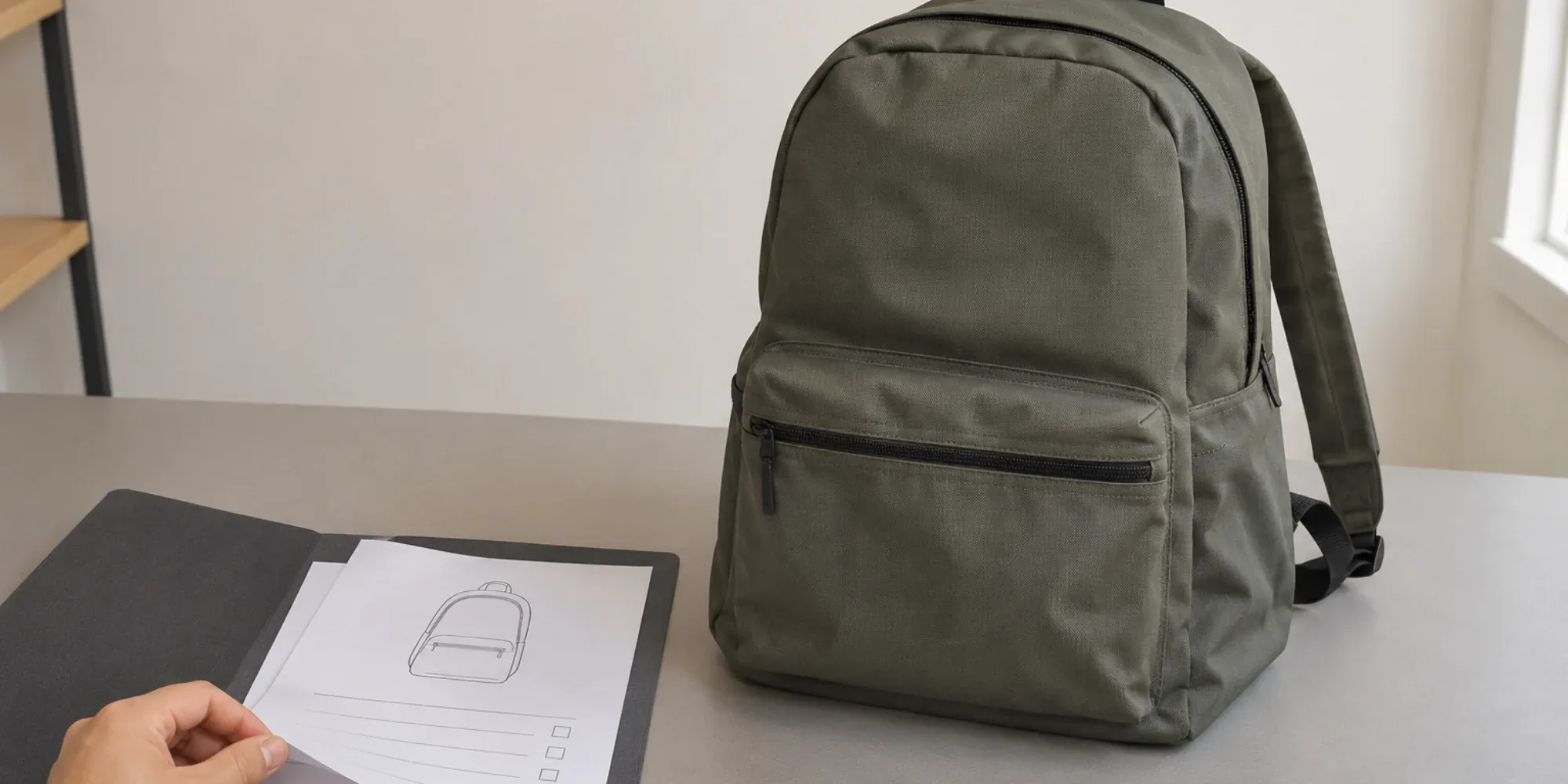
Evaluating a custom backpack manufacturer requires looking past the initial prototype to assess their production systems, quality control frameworks, and sourcing transparency. Key trust signals include documented Acceptable Quality Limit (AQL) sampling, systematic defect management, and partnerships with established hardware suppliers. Buyer proof is established through verifiable third-party material certifications, such as SCS Recycled Content or Leather Working Group (LWG) audits, ensuring that environmental and material sourcing claims are backed by independent standards.
Moving Beyond the Golden Sample: Production Systems as Trust Signals
When evaluating custom backpack manufacturers, buyers often begin by requesting a prototype. While a physical sample is necessary to check design details, material choices, and initial construction, it is only a starting point. Sourcing managers frequently fall into the trap of treating a flawless prototype as definitive proof of a factory's capability. However, a single perfect bag does not answer the most critical decision question for high-volume procurement: can the facility replicate this exact standard thousands of times during bulk production without introducing crippling variances?
The disconnect between a prototype and a production run occurs because samples are typically produced under entirely different conditions than bulk orders. A golden sample is usually crafted by highly experienced sample makers working in a specialized research and development room. These artisans dedicate hours or days to meticulously cutting, sewing, and finishing a single unit by hand. This customized process bypasses the actual assembly line, bulk material cutting machines, and the standard operating procedures used by everyday line operators. In bulk production, variables such as machine calibration, operator fatigue, and batch material handling come into play. Consequently, evaluating only the sample tests the skill of a single master sewer, not the reliability of the facility's manufacturing operations.
To secure predictable outcomes, buyers must shift their focus from the product itself to the underlying production system. Structured workflows and established quality control frameworks serve as true trust signals during the vetting process. When interviewing a potential manufacturing partner, buyers should ask how the factory transitions a design from the sample room to the factory floor. Reliable facilities maintain clear, documented processes for translating prototype specifications into comprehensive tech packs and standardized operating procedures, ensuring every line worker understands the required tolerances and assembly methods for that specific custom backpack.
One of the strongest indicators of a mature cut-and-sew production environment is a systematic approach to defect management during manual assembly. While automated manufacturing might rely on complex statistical process controls, manual backpack assembly typically uses ISO standard Acceptable Quality Limit (AQL) random sampling. When a factory actively defines and documents AQL thresholds for major and minor defects before production begins, it demonstrates a systemic commitment to reducing the operational variability that leads to flawed deliveries. This structured oversight is vastly more reliable than simply hoping the bulk production line matches the sample room's output.
- How do you document and transfer construction specifications from the approved golden sample to the main production line?
- Do you utilize documented standard operating procedures to manage the transition from raw material staging to final assembly?
- How do you implement ISO standard Acceptable Quality Limit (AQL) sampling to monitor consistency across different operator stations?
- What specific systems are in place to address variances during a large cut-and-sew production run?
Facilities that struggle to answer these baseline questions often rely on reactive troubleshooting rather than proactive quality management. If a manufacturer cannot articulate their cut-and-sew methodologies and sampling standards, the risk of inconsistent stitching, hardware misalignment, or material flaws in the final delivery increases significantly. By demanding visibility into their specific workflow organization and AQL protocols, buyers establish a clear standard for accountability. This ensures that the excellence seen in the initial prototype is systematically engineered into every custom backpack leaving the factory.
Buyer Proof: Validating Quality Control and Defect Management
Moving beyond initial prototype evaluation, sourcing managers must secure concrete buyer proof that a manufacturer can deliver consistent quality across high-volume orders. In manual cut-and-sew soft goods production, trust cannot be based on verbal assurances, marketing claims, or isolated pristine samples. Instead, the most reliable trust signals are documented quality control protocols that systematically track, manage, and reduce manufacturing defects directly on the assembly line. Without these objective operational mechanisms, a facility is merely guessing at its own consistency and reliability.
The standard for validating this manufacturing capability in the backpack industry is the documented use of Acceptable Quality Limit (AQL) sampling. Unlike highly automated industrial manufacturing that relies on continuous statistical control sensors, custom backpack assembly is a distinctly human-driven process. Natural variations in fabric tension, sewing speed, and material handling require a standardized approach to batch inspection. By defining specific AQL thresholds for critical, major, and minor defects before production begins, manufacturers establish a concrete, measurable baseline for what constitutes acceptable variance across thousands of manually sewn units.
For a buyer evaluating custom backpack manufacturers, these quality frameworks translate into highly specific decision questions regarding daily factory operations. AQL is not simply a final visual check at the shipping dock; it involves structured, randomized sampling at multiple discrete stages, including raw material staging, in-line panel assembly, and final packing. In a large production run, factors like sewing machine tension drift, fabric alignment errors, or needle dulling can gradually introduce significant defects. A facility utilizing rigorous in-line AQL protocols intercepts these negative shifts early, long before an entire batch of custom backpacks requires costly and time-consuming manual rework.
Furthermore, proactive risk assessment during the transition to bulk manufacturing serves as essential preventative buyer proof. When onboarding a new custom backpack design, a mature factory will conduct thorough pre-production meetings to anticipate exactly where structural failures might occur. They will analyze the specific design, such as a heavy-duty laptop compartment, a complex zipper gusset, or a load-bearing shoulder strap, to identify potential manufacturing bottlenecks and stress points. If the production team identifies a high risk for strap detachment under heavy loads, they will implement specific preventative steps—such as specifying a bartack stitch or upgrading the thread gauge in the standard operating procedure—before bulk production even begins.
- Do you utilize recognized Acceptable Quality Limit (AQL) sampling to monitor assembly line variances, and can you share sample inspection documentation?
- How do you conduct pre-production risk assessments on new custom backpack designs prior to launching bulk manufacturing?
- What is your standard process for categorizing critical, major, and minor defects when inspecting load-bearing seams?
- How are corrective actions documented and communicated to the factory floor when a recurring stitching or alignment issue is identified?
The necessity of these structured inspection frameworks depends heavily on the scale of production. Smaller, artisanal runs of a few dozen bags might reasonably rely on one hundred percent manual visual inspection by a single supervisor to catch dropped stitches or misaligned panels. However, once production scales to hundreds or thousands of units, strictly manual full-run inspection becomes statistically prone to human fatigue and costly oversight. For high-volume B2B sourcing, the implementation of structured, randomized AQL frameworks becomes a non-negotiable requirement for ensuring predictable bulk deliveries.
While a sourcing manager might initially browse a manufacturer's Home page to review general capacities, stated lead times, and available product categories, evaluating their documented defect management methodologies provides the verifiable evidence necessary to authorize a bulk contract. A manufacturer willing to share its quality inspection frameworks demonstrates transparent, predictable operations that protect the buyer's brand reputation. For company-specific information, see GFBags.
Component Sourcing: Why Hardware and Zippers Matter
Backpacks are highly dynamic products. During daily commuting or travel, the main body fabric rarely fails first; instead, catastrophic product failures typically occur at high-stress mechanical points like zippers, buckles, and strap adjusters. Because these small components endure continuous cyclic fatigue, tension, and shock loading, a manufacturer's approach to component sourcing serves as a highly accurate proxy for their overall commitment to structural integrity. When vetting a custom backpack partner, analyzing their hardware supply chain is a critical trust signal for any sourcing manager.
A reliable manufacturer does not treat hardware as a generic commodity to be swapped out for the cheapest available alternative between production batches. Instead, they establish long-term sourcing relationships with reputable component suppliers. The presence of recognized, branded hardware on a factory's standard Bill of Materials (BOM) frequently suggests an intentional prioritization of durability over absolute cost reduction, indicating an awareness of the reputational and warranty costs associated with component failure.
Established component suppliers often participate directly in shaping quality benchmarks. For example, the zipper manufacturing enterprise SBS states that it develops high-quality zipper products while also undertaking the secretariat for national zipper standardization subcommittees. sbszipper.com
Sourcing managers must understand the strict tradeoffs involved in hardware selection. Utilizing unbranded or heavily localized generic hardware can noticeably reduce the per-unit cost of a custom backpack. However, this upfront cost reduction directly correlates with a higher probability of zipper tooth misalignment, slider derailment, and plastic buckle snapping under heavy loads or extreme temperature conditions. If a factory insists on generic hardware without providing cycle-test data or load-bearing limits, this represents a negative trust signal indicating potential reliability issues in bulk production. While the way hardware is sewn into the bag—such as double-stitching zipper tapes or bartacking webbing loops—is critical, the physical component itself dictates the absolute baseline limitation.
- Require a detailed BOM: Ensure that the exact brand, material composite (e.g., nylon, polyacetal, or zinc alloy), and gauge size of every zipper and buckle are explicitly listed.
- Request performance thresholds: Ask the manufacturer for cycle-testing data for zippers and tensile strength limits for critical load-bearing hardware.
- Verify substitution policies: Establish contractual safeguards that strictly prohibit the manufacturer from swapping a specified hardware brand for a generic alternative without prior written approval.
- Evaluate structural limits: During sample review, manually verify that the zipper actuates smoothly to confirm proper tooth engagement, but require formal laboratory tensile test reports to accurately determine crosswise lateral burst strength under heavy packing loads.
By anchoring the evaluation on these specific failure points, procurement teams can validate whether a backpack manufacturer possesses the sourcing discipline necessary to produce reliable soft goods. A factory that is transparent about its component partners is significantly more likely to maintain consistent quality across large-scale B2B orders.
Verifying Material Claims: Sustainability and Audits
In the custom backpack market, eco-friendly or sustainable material claims are frequently used to attract environmentally conscious brands. However, accepting these marketing terms at face value introduces significant risk. Without independent validation, a sourcing manager cannot reliably confirm whether a fabric genuinely contains post-consumer recycled polymers or if a factory minimizes environmental harm. To protect brand integrity and avoid accusations of greenwashing, buyers must demand definitive buyer proof that the environmental specifications match the physical inputs utilized on the factory floor during bulk production.
The most robust trust signal for material authenticity is the presence of recognized third-party certifications. When vetting a potential manufacturer, the primary decision question should not simply be whether they offer sustainable fabrics, but which independent auditing bodies verify them. A manufacturer that proactively volunteers current, traceable certificates demonstrates operational transparency and a mature supply chain. Conversely, a factory relying solely on unverified supplier letters or internal verbal guarantees presents a high risk of material substitution.
For backpacks utilizing synthetic fabrics like recycled polyester, validating the exact percentage of post-consumer waste is critical. Buyers can establish this proof by requiring documentation from established authorities. For instance, SCS Global Services launched its third-party certification program for recycled content claims in 1989. According to its own corporate statements, SCS asserts it delivers the most comprehensive assessment and certification for recycled content in the market. Sourcing from manufacturers maintaining this documentation validates a brand's environmental claims. Furthermore, SCS notes it offers a private label certification allowing customers of certified manufacturers to rebrand those certified products under their own company name. Recycled Content Certification | ISO 14021 & SCS‑103 | SCS
If a backpack design incorporates organic materials like premium leather for base panels or reinforced handles, verification criteria must shift to address the specific impacts of tanning. Leather production can involve significant water usage and chemical processing. Therefore, a manufacturer claiming to use sustainable leather must trace their hides back to responsibly managed facilities. This traceability serves as vital buyer proof that raw materials align with the brand's ethical standards.
To verify these leather sourcing claims, managers should look for alignment with industry-specific organizations. Established in 2005 as a collaborative initiative among leading brands and manufacturers, the Leather Working Group is a global non-profit focused on sustainable leather production. The organization states that its multi-stakeholder initiative is committed to building a world where leather is sourced sustainably to protect people and the planet. Checking if a manufacturer sources from facilities audited by this initiative ensures that procurement aligns with these documented standards, providing a clear evaluation framework. What we do – Leather Working Group
- Can you provide current third-party audit certificates for the specific recycled fabrics proposed for our backpack production run?
- Is your leather sourced exclusively from facilities audited by the Leather Working Group, and can you provide supply chain traceability?
- Do your material certifications allow for private label rebranding under our specific brand name?
- How does your facility physically segregate certified sustainable materials from conventional bulk fabrics to prevent cross-contamination?
Navigating these certifications involves clear operational tradeoffs. Procuring certified recycled fabrics or responsibly audited leather typically increases raw material costs and can extend lead times due to tighter supply chain controls. Buyers must balance these higher upfront costs against their margin requirements. If a brand cannot absorb the premium associated with verified sustainable materials, it is often a better operational decision to pivot to conventional materials. Selecting a strong conventional nylon is a safer compliance strategy than paying a premium for an unverified green fabric that might expose the brand to greenwashing accusations. Environmental verification strictly ensures compliance and marketing accuracy, serving a distinctly separate purpose from testing physical load-bearing durability.
Assessing B2B Customization and Service Capabilities
While material audits and rigorous quality control systems secure the physical integrity of a custom backpack, sourcing managers must also evaluate the operational flexibility of the manufacturer. In high-volume procurement, the relationship extends far beyond a straightforward transactional purchase. A facility might possess excellent sewing capabilities but entirely lack the administrative infrastructure to manage complex communication, staggered delivery schedules, or nuanced brand requirements. Evaluating a manufacturer's business-to-business service capabilities is a crucial step in establishing long-term buyer proof, separating rigid assembly lines from responsive manufacturing partners.
Academic literature examining the bag manufacturing sector often categorizes elements such as customization, corporate gift production, and a customer-centric approach as distinct components of overarching B2B sales strategies. Strategies for Effective B2B Sales in the Corporate Gifts Industry: Best Practices and Success Tactics in the w.r.t Bag Manufacturing in Ahmedabad City | International Journal of Business and Management Practices (IJBMP)
In practical terms, a manufacturer that actively structures its daily operations to accommodate specific corporate requirements demonstrates an operational maturity that goes well beyond simply pushing standardized templates. This highly structured methodology ensures that the factory is adequately prepared to adapt its production workflows to meet the unique branding, complex delivery timelines, and structural demands of each individual client. Without this foundational flexibility, buyers are frequently forced to compromise their original design vision and functional requirements simply to fit a factory's rigid, predetermined assembly processes.
True customization introduces significant operational complexity. There is a distinct tradeoff between selecting a factory that merely applies a logo to an existing, off-the-shelf design and one that engineers a completely new backpack architecture from raw materials. Deep structural customization requires dedicated account management, prototyping engineers, and a flexible supply chain capable of sourcing distinct textiles for varying corporate or retail projects. A facility equipped to offer comprehensive Custom Service must maintain highly agile communication channels to manage these variables without causing crippling production delays. Buyers should assess whether the manufacturer provides a dedicated team to navigate the inevitable design revisions that occur when translating a two-dimensional tech pack into a mass-produced soft good. For company-specific information, see GFBags.
- How does your engineering team manage and document mid-development specification changes if a structural modification is required after the first sample?
- What is the exact workflow for translating strict corporate brand guidelines into physical applications like localized embroidery, heat transfers, or custom hardware debossing?
- When a completely unique textile or hardware component is requested, how is that specialized procurement integrated into your standard production lead times?
- Do you assign a dedicated account manager to oversee the project from initial prototyping through to final bulk delivery and shipping logistics?
Factories that struggle to answer these specific service-oriented questions often lack the internal infrastructure required to handle high-stakes business-to-business contracts successfully. If a manufacturer is consistently slow to respond during the initial quoting phase or pushes back heavily against reasonable structural modifications, this behavior serves as a highly visible negative trust signal indicating how they will manage unexpected disruptions during bulk production. Conversely, a manufacturer that proactively outlines its detailed customization workflow provides concrete buyer proof that they possess the administrative and operational maturity required to serve as a reliable, long-term supply chain partner.
Frequently Asked Questions for Vetting Manufacturers
Entering direct negotiations with a custom backpack manufacturer requires a structured approach to operational verification. To finalize a sourcing decision, buyers must translate their core requirements for quality control, material authenticity, and component reliability into targeted frequently asked questions. Responses to these vetting questions serve as ultimate trust signals, separating factories relying on vague assurances from those equipped with verifiable production safeguards. A comprehensive evaluation ensures the supplier's true capabilities align with the buyer's standards for large-scale procurement. Moving beyond a simple prototype review protects the buyer from costly structural surprises later. By shifting focus from a meticulously sewn sample to the facility's day-to-day manufacturing discipline, sourcing managers establish objective buyer proof.
Academic literature reviewing the bag manufacturing sector identifies key components such as customization, corporate gift production, and a customer-centric approach as fundamental elements of effective business-to-business sales strategies. Strategies for Effective B2B Sales in the Corporate Gifts Industry: Best Practices and Success Tactics in the w.r.t Bag Manufacturing in Ahmedabad City | International Journal of Business and Management Practices (IJBMP)
In practical sourcing scenarios, a buyer must determine if a manufacturer can actually execute this customer-centric customization without causing severe bottlenecks on the factory floor. When formally vetting a prospective partner, managers should ask specific questions about the facility's internal workflow organization and its capacity for continuous operational adaptation. Understanding exactly how a supplier scales these intricate corporate design requests while successfully maintaining consistent delivery schedules provides crucial insight into their overall operational stability. This flexibility is a primary indicator of a factory's long-term viability as a reliable supply chain partner.
- How do your specific business-to-business workflows accommodate highly customized soft goods orders without disrupting standard production timelines?
- What exact protocols do you follow to ensure standard operating procedures are effectively communicated to manual assembly line operators when launching a newly customized cut-and-sew design?
- Do you provide a dedicated account manager to navigate specification changes and maintain clear communication throughout the bulk manufacturing phases?
Another critical area of inquiry involves the manufacturer's capacity to control cut-and-sew defects systematically. Asking general questions about quality inspections often yields vague assurances about visual sorting at the very end of the assembly line. Instead, buyers must secure definitive buyer proof by asking precisely how the factory uses documented, standardized sampling methods to intercept structural failures before entire batches are compromised. A facility tracking its defect rates during active production demonstrates a stronger commitment to continuous improvement than one relying on reactive troubleshooting.
Furthermore, procurement teams must strictly verify the manufacturer's sourcing discipline regarding high-stress mechanical components like zippers and buckles. Selecting hardware from established component suppliers can serve as an important baseline for component reliability. For instance, the zipper manufacturing enterprise SBS asserts in its corporate materials that it develops high-quality products while undertaking the secretariat for national zipper standardization subcommittees. Since generic hardware remains a primary point of structural failure in daily use, establishing strict component sourcing guidelines during the vetting process prevents costly downstream warranty issues. sbszipper.com
- Do you utilize recognized Acceptable Quality Limit random sampling thresholds to inspect manual cut-and-sew variances across bulk production runs?
- How does your facility document and communicate prioritized corrective actions to the assembly line operators when a structural defect is identified?
- Will you commit to using specified hardware from established component brands and strictly prohibit unapproved generic substitutions during bulk assembly?
Environmental marketing claims require rigorous independent verification to successfully mitigate greenwashing risks. If a custom backpack project incorporates sustainable synthetic textiles or responsibly sourced leather panels, the sourcing manager must demand explicit documentation prior to finalizing the contract. A trustworthy manufacturer will readily supply current, traceable certificates from recognized third-party auditing bodies rather than expecting the buyer to rely entirely on internal factory guarantees. Validating this specific documentation ensures that the factory actually purchases the correct eco-friendly materials for that exact production run, rather than substituting cheaper conventional fabrics.
- Can you supply current third-party assessments, such as SCS Global Services Recycled Content certification, for the proposed synthetic fabrics used in our design?
- Does your material certification allow for private label certification, enabling us to rebrand the verified sustainable products under our own company name?
- If our backpack design includes leather panels or pulls, do you source exclusively from facilities audited by the Leather Working Group to ensure adherence to their specific environmental and sourcing criteria? Recycled Content Certification | ISO 14021 & SCS‑103 | SCS What we do – Leather Working Group
Synthesizing these vetting questions into a formal sourcing checklist prevents critical ambiguities during final contract formation. A prospective manufacturer that struggles to articulate its manual defect management frameworks, hesitates to confirm specific hardware brands on the bill of materials, or fails to produce valid sustainability audits presents a high operational risk. Conversely, a factory providing transparent answers to these frequently asked questions demonstrates the operational maturity necessary for a stable business-to-business partnership. Prudent buyers should append the agreed-upon answers directly into the manufacturing agreement to ensure accountability. By demanding concrete buyer proof across customization workflows, quality control sampling, and certified material sourcing, procurement managers can confidently select a manufacturing partner capable of delivering consistent custom backpacks at scale. The goal is transitioning seamlessly from evaluating a single prototype to reliably securing a predictable manufacturing process.
Sources
- sbszipper.com
- Recycled Content Certification | ISO 14021 & SCS‑103 | SCS
- What we do – Leather Working Group
- Strategies for Effective B2B Sales in the Corporate Gifts Industry: Best Practices and Success Tactics in the w.r.t Bag Manufacturing in Ahmedabad City | International Journal of Business and Management Practices (IJBMP)